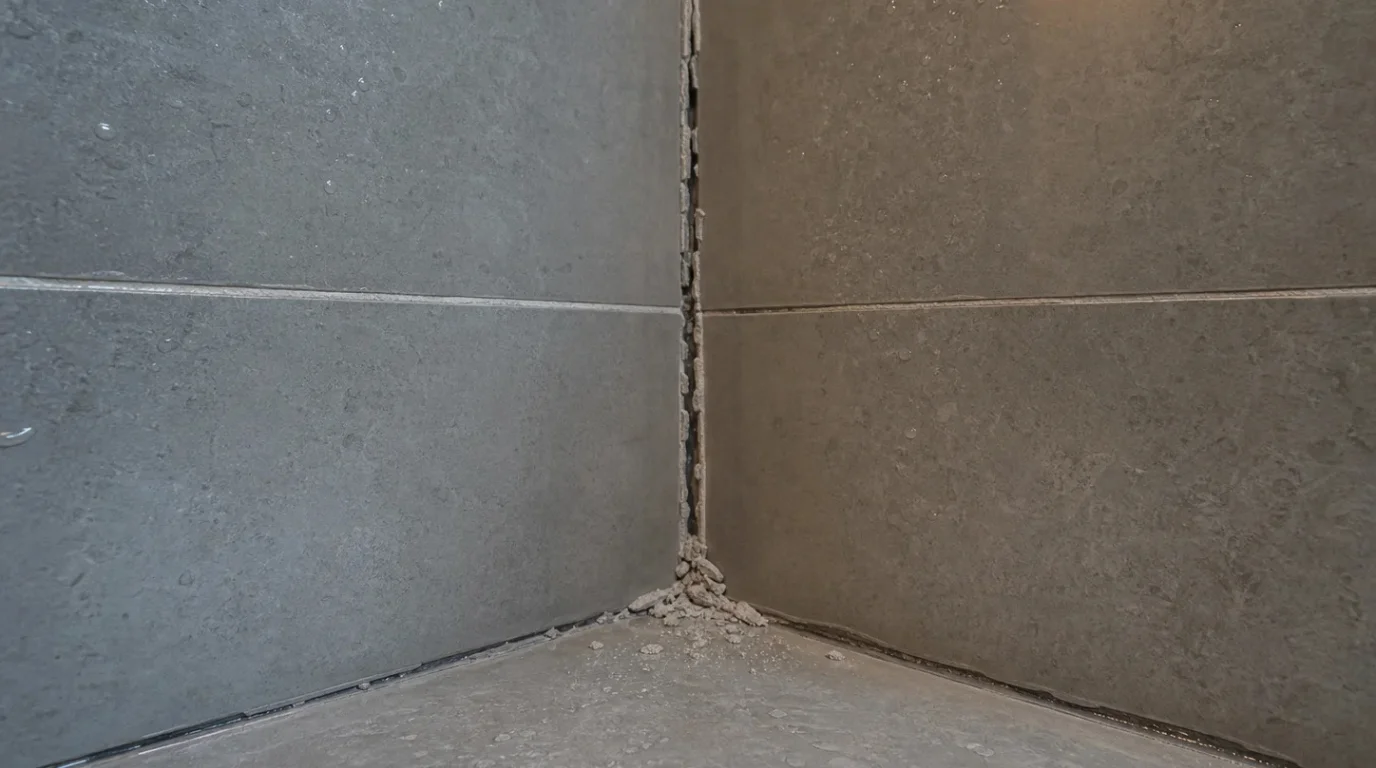
There is a particular line in every tiled bathroom that fails first. It runs vertically up the inside corner of the shower, or horizontally where the wall tiles meet the floor. It starts as a hairline, then a piece drops out, then the gap fills with grey-brown residue that will not scrub off. Some of that film is limescale from our water, which is a cleaning job, and it is covered in how to remove hard water stains in Dubai. You regrout it. It cracks again within a year.
That is not bad luck, and it is not a sign the tiles were laid badly everywhere. It is almost always a joint that was never meant to be grouted.
Grout is a filler. A corner is a movement joint
Grout is cement-based and rigid once cured. It is designed to fill the gap between two tiles that sit on the same flat plane and move together. It is not designed to stretch.
Corners and changes of plane are the opposite situation. Two surfaces meet at ninety degrees, they are usually made of different materials or built at different times, and they move relative to each other constantly: the wall flexes microscopically, the floor screed expands and contracts with temperature, the shower base has its own movement, and a bathtub shifts when it is filled. A rigid material sitting in that junction has only two options, and it takes the second one. It cracks.
This is why the guidance in tile standards is unambiguous about where flexible sealant belongs. ANSI and TCNA references point to 100% silicone at inside corners and at changes of plane, and it is not a stylistic preference. The joint has to be able to compress and recover, which is also why a rigid repair in the same place fails again within a season.
Where silicone or a flexible sealant belongs instead of grout:
- Both inside corners of a shower, wall to wall.
- Wall to floor, all the way around a shower or wet room.
- Where tile meets a bathtub, shower tray, bench, niche shelf or vanity top.
- Where a tiled wall meets another wall, a ceiling, or a plastered surface.
- Around a floor waste, a skirting, a threshold and a door frame.
- The perimeter of any balcony or terrace tiling, and at joints across a large floor area.
- Around pool coping, the joint between deck paving and the pool shell, and where a wet deck meets a vertical wall. A pool edge is a change of plane like any other, and it also carries the scale problem discussed in the white ring on your pool tiles.
- Where tiling meets a glass screen fixed to tile.
The rule of thumb a tiler uses: if the two surfaces either side of the line are not the same material, or not the same plane, or not fixed to the same structure, do not fill that line with grout.
“But we used epoxy grout, so it should be flexible”
Epoxy grout is a better material in almost every way that matters in a wet room. It is non-porous, so it does not take up water, does not feed mould the way cementitious grout does, and does not stain from our hard water. It has some give compared to cement grout, since it is resin-based.
It is still a rigid grout. It will not absorb the movement in a corner, and it will not stop water getting behind a joint that has opened. What is worse, a cracked epoxy joint is harder to rake out and much harder to bond a repair into. Choosing epoxy in the field of the tiles and silicone in the corners is the right combination. Choosing epoxy everywhere, including the corners, is the mistake the upsell sells. If the tile itself is still being chosen, the trade-offs between porcelain and natural stone are set out in porcelain vs marble flooring in Dubai, and the same logic applies to which joint material goes where.
The two-finger test: is this cosmetic or is it leaking
Cracked grout is usually cosmetic. Cracked grout in a corner is occasionally the visible end of a waterproofing problem. Run these checks before you decide how much to spend.
- Press a dry fingertip into the gap and pull. A hairline craze with the tile edges still tight is cosmetic. If you can feel the two surfaces moving independently, or the gap is more than a couple of millimetres wide, the joint has opened properly.
- Look for the tide mark. Damp, blistered or discoloured paint on the wall on the other side of that corner, or a staining line at the base of the wall, means water is crossing it.
- Check the ceiling below. A yellow ring in the room underneath a bathroom is never a cosmetic finding.
- Tap the tiles either side of the cracked line. Solid is a short, hard sound. A drum note means the bed has debonded, which changes the job.
- Watch the salt. A white powdery bloom creeping out along the joint as it dries is moisture travelling through the assembly, and the corner is its exit.
If 2, 3, 4 or 5 apply, resealing the corner is the last step, not the first. Find where the water is coming from first. The most common source in a bathroom that is otherwise fine is a floor that holds water, and we set that out in water pooling in your shower floor.
Why this shows up more in Dubai than the advice you read assumes
Three local factors accelerate corner failure.
Temperature swing. A tiled surface in a villa bathroom or on a terrace can sit near 40 degrees in the afternoon and 22 after the AC has run for an hour. That is daily, seasonal cycling on the adhesive and grout lines, and it is exactly the load a rigid joint in a corner cannot take. Interior tiles with an external wall behind them do worse than tiles on an internal partition. The same daily cycle of heat, cooling and hard water is what we map across the whole building in how Dubai summer heat quietly damages your home.
New-build movement. Most villas and many apartments keep moving slightly through their first two or three years, and the movement shows up first at the weakest link in the finishes, which is a grouted corner or a rigid joint at a ceiling line. If your crack appeared 12 to 18 months after handover, that is the likely mechanism, and it is worth having recorded while the finishes are still within the developer maintenance period.
Cleaning habits. Hosing a balcony, jet-washing a tiled terrace, or flooding a bathroom floor during cleaning forces water into a joint under pressure, several times the head of water the same joint sees in a shower. Rigid grout plus pressure plus a hairline crack is how a “no leak” balcony ends up with a damp ceiling below.
How to convert a cracked grout corner into a proper movement joint
This is a genuine repair, not a top-up. The two most common failures are doing it over the old grout, and using decorator’s caulk.
What to buy. A sanitary-grade, mould-resistant 100% silicone in a colour matched to your grout. Neutral cure where stone is involved, since some acid-cure products can mark natural stone. Never use an acrylic or “paintable” decorator’s caulk in a wet area, and never use a sanded caulk as a substitute for the joint.
- Rake out the grout in the corner to a depth of at least two thirds of the tile thickness. A manual grout rake or a oscillating tool with a diamond blade, working along the corner only.
- Vacuum the channel and wipe it with isopropyl alcohol. Dust is the reason the new bead peels out in six months.
- Mask both sides of the joint with tape so the bead has a straight edge. This is what separates a repair you can see from one you cannot.
- Check the substrate is dry. Sealing a damp corner traps the moisture inside the assembly, which is the same mistake as sealing a floor that is still drying out.
- Apply a continuous bead without stopping mid-run, then tool it with a wetted finger or a profiling tool to press it into the joint and leave a slight concave finish.
- Remove the tape immediately, before a skin forms.
- Leave it undisturbed for the manufacturer’s cure time, typically 24 hours, and no shower on it before then.
Replace silicone at the tray and bath edges the same way when it has gone hard, cracked or black at the base. New silicone over old is a cosmetic layer that peels within months.
If you are a tenant preparing to hand a property back, renewing bathroom silicone is the single best-value hour on the whole list, and it is itemised in the move-out walkthrough.
If you regrout the flat joints as well, do the corner in silicone after the grout has cured, not instead of it. Some tilers deliberately grout the corner first, then cut and remove it and silicone over, so that the joint colour matches the field perfectly. That is a legitimate technique, not a shortcut.
What a tiler should be doing when they retile your bathroom
Ask these five questions, and the answers tell you the standard of the job:
- Which joints will be silicone rather than grout, and what product?
- Where will movement joints go across a floor over 3 metres or a wall over 6?
- What is the fall to the floor waste, in millimetres per metre?
- Is the waterproofing being renewed, and will there be a 24-hour pond test before tiles?
- Is epoxy grout specified in the wet zone, and what adhesive for the tile format?
Movement joints in the field of a floor matter as much as corners. Spacing commonly specified for interior floors is on the order of every 2.5 to 3 metres, with joints at every perimeter, change of plane and junction with a wall or column, and closer spacing outdoors where the sun is on the tiles. A large-format porcelain floor in a Dubai villa with no movement joints is a floor that will start tenting or popping tiles in a couple of summers. If the corner joints are failing across several rooms, that is a scope conversation for a bathroom renovation rather than a tube of sealant, and a yearly joint and silicone check is one of the cheapest lines to add to an annual maintenance contract.
When it is not the corner
Three look-alikes worth ruling out:
- Powdering grout across the whole floor, not just corners. That is usually washout: grout that was flooded with water during cleaning, or walked on too early, or mixed too thin. It needs replacing, not sealing.
- Craze lines running through the tile face as well as the joint. Movement in the substrate. A corner repair will not help a cracked tile.
- A dark line that stays damp and smells musty. Water sitting in the assembly, and the joint is the symptom. This is where the diagnosis has to start at the drain and the falls, not at the sealant tube. Standing water in a shower is the most reliable way to destroy a corner from the inside, and water pooling in your shower floor covers how that is proved and repaired.
We handle the tile and waterproofing side of all three: tiling and grout renewal and bathroom works. Send a photo of the corner and a short clip of you pressing it, plus one of the wall on the other side, and we will tell you whether it needs a sealant conversion or a floor lifted. Request an inspection or read what clients say about how we finish jobs.
Frequently asked questions
Should shower corners be grouted or filled with silicone?
Silicone. Inside corners and any change of plane are movement joints, and rigid grout cracks in them. Tile standards recommend 100% silicone at those junctions. Grout belongs between tiles on the same flat surface.
Why does my newly regrouted corner keep cracking again?
Because the joint moved and the new grout was rigid again. Regrout in the same place without converting the corner to a flexible sealant and the crack returns, usually within a year. It can also mean movement in the substrate, which no sealant fixes permanently.
Can I just run silicone over the cracked grout?
No. It looks finished for a few months and then peels away with the loose grout behind it, and it seals dirt and moisture against the tile edges. The old grout has to be raked out to create a proper joint depth, then the channel cleaned and dried.
Is epoxy grout waterproof enough for a shower corner?
Epoxy is excellent for the field of the joints, and it resists staining and mould far better than cement grout. It is still rigid, so it does not perform as a movement joint in a corner. Use epoxy between tiles and colour-matched silicone at corners and changes of plane.
Is a cracked grout line a waterproofing failure?
Not by itself. Grout is not a waterproof layer under any circumstances, so a small crack does not automatically mean a leak. It becomes a real problem when water is being delivered to that crack continuously, which is what happens with a shower floor that has no fall and holds water.
How long does silicone in a shower last?
A well-prepared, clean, dry joint with quality sanitary silicone should give several years before it needs renewing. Failure inside a year is nearly always a preparation problem: dust, damp substrate, old grout left in the joint, or a bead applied too thin to compress with the movement.