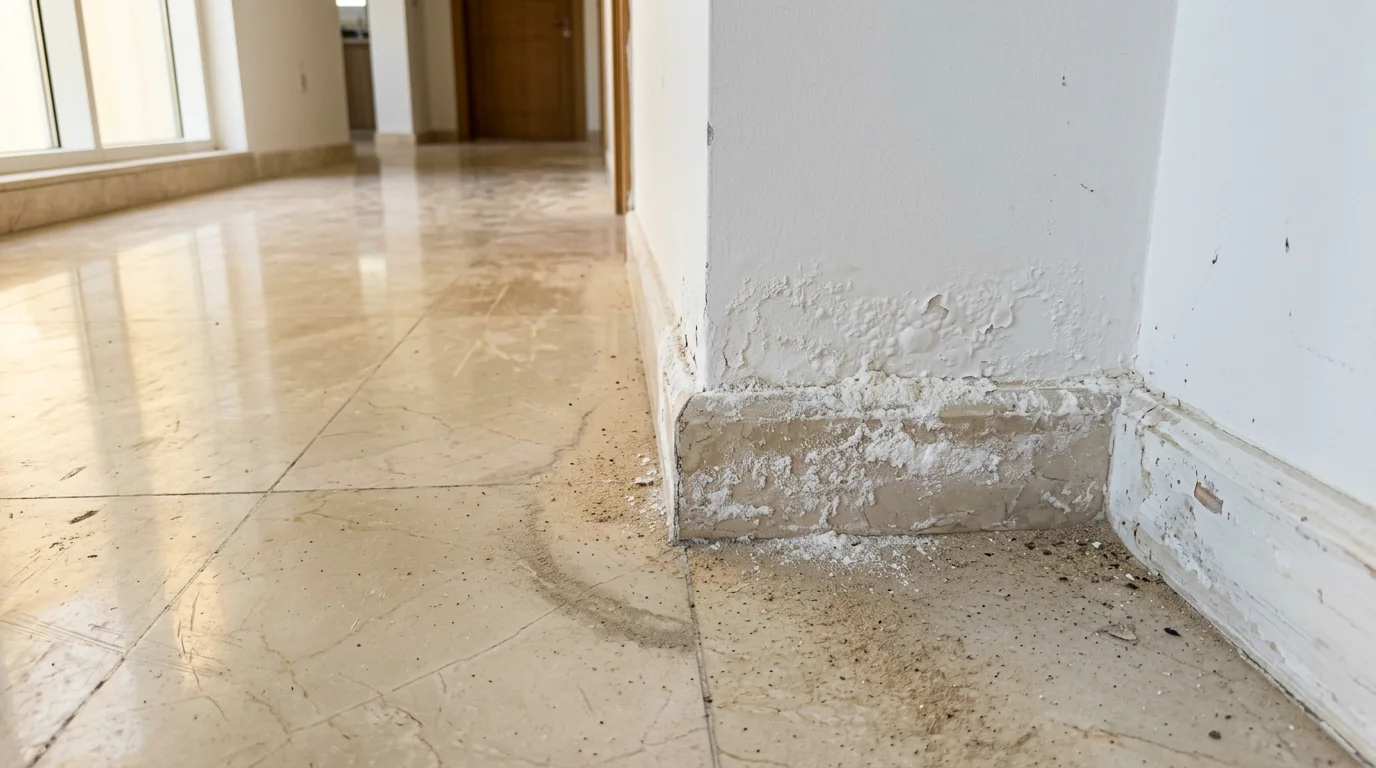
You sweep it up. It looks fine for two days. Then a chalky white line shows up again along the grout, or a pale bloom creeps across the marble near the wall, and the more you mop it the more visible it gets.
If you search for this, almost every answer tells you to scrub it with vinegar or a limescale remover. On marble that advice is how floors get permanently ruined, because acid eats the polish out of calcium carbonate stone. So before you do anything, you need to know which of the four white deposits you actually have.
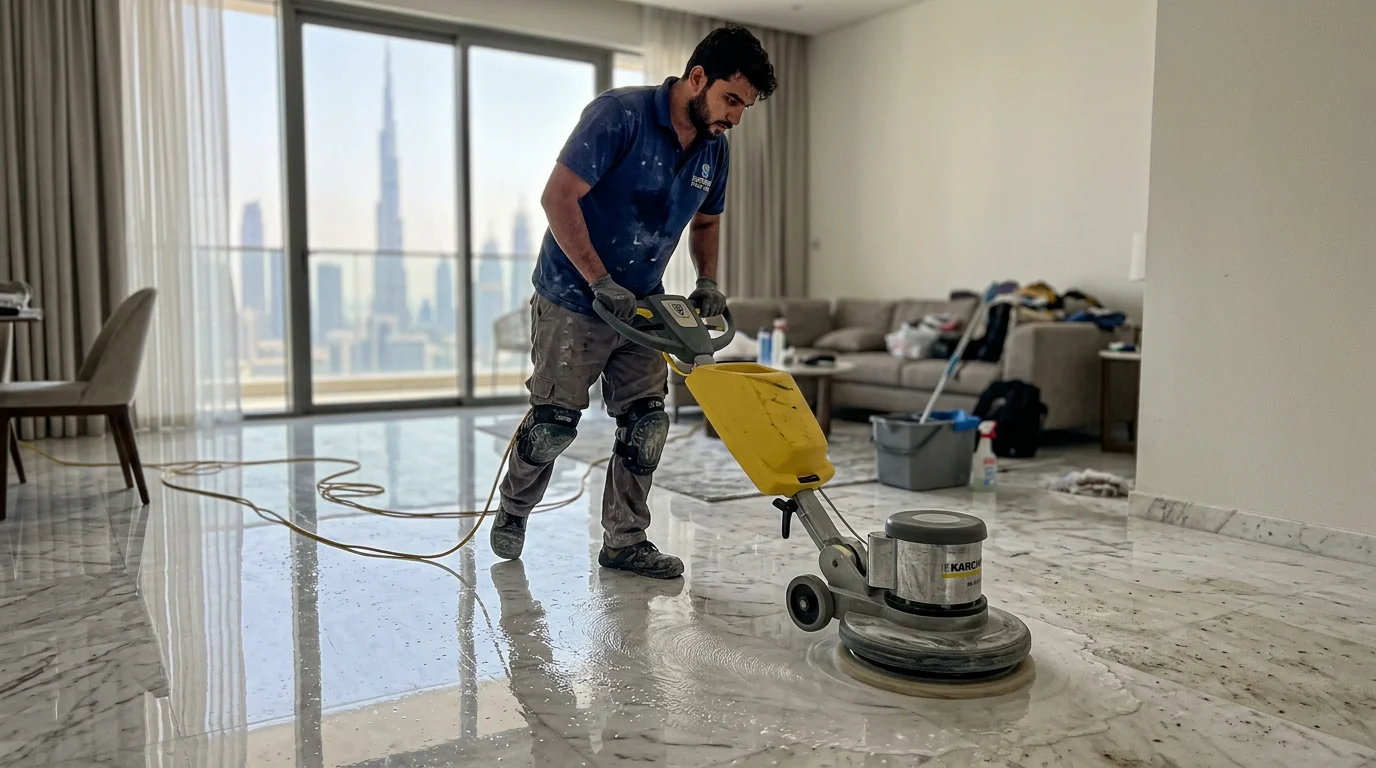
We work on stone and tile across Dubai, in villas where the ground floor sweats, in apartments where a shower has been leaking sideways for a year, and in offices where a condensate line is discharging into a bulkhead. Here is how to identify it, what is really feeding it, and the short list of things that make it worse.
What the white powder actually is
The technical name is efflorescence, and the mechanism is simple.
- Water moves through a cement-based part of your floor or wall, which means the screed, the tile adhesive, the grout, or the ground beneath a ground-floor slab.
- As it moves, it dissolves soluble salts that are naturally present in cement and in Gulf sand and soil: calcium hydroxide, sulfates, chlorides.
- The water reaches the surface and evaporates. The salt cannot evaporate, so it is left behind as a crystalline powder.
- More water arrives, the cycle repeats, and the deposit grows.
That is why the powder is alkaline, why it comes back after cleaning, and why it is usually thickest along a joint or a tile edge, where the water has its easiest escape route. It is also why the same floor can look perfect in a cool, humid month and bloom dramatically in the first hot week of the season: heat and dry air speed up evaporation at the surface, which pulls more moisture out through the stone.
One more consequence matters long term. Salt does not just sit there, it crystallises, and crystallising salt pushes. Enough cycles will open hairline cracks in the polished layer, roughen the stone surface until it feels sugary, and loosen tiles from the bed. The white powder is the visible part of a slow physical process.
Four white deposits, and the 48-hour test that tells them apart
Do this first. It takes two minutes and one cloth, and it changes everything about what you do next.
Pick a tile or a small area. Photograph it. Dry-brush or vacuum the deposit away, no water at all. Leave that square alone for 48 hours with the room in normal use.
| What you see now | What came back in 48 hours | Diagnosis |
|---|---|---|
| Nothing came back, the area stays clean | Nothing | Ordinary dust and sand, or a one-off spill. Clean properly and move on |
| The same white fuzz returns from the grout line or the tile edge | It regrows from within | Efflorescence. Moisture is moving through the floor or wall. This is the one that matters |
| A milky, slightly soft film that dulls dark grout | It stays as a film, does not grow as powder | Sealer haze. Someone applied a sealer too heavily, or buffed it too late |
| A rainbow or cloudy skin, sometimes slightly sticky | Returns as a skin after drying | Latex bloom from too much water in the grout mix or the cleanup, common after a fresh re-grout |
| A hard chalky crust that only sits where water splashes: taps, glass, the shower screen, the tile face near the tray | Builds up slowly over weeks, not days | Limescale from our hard water. Different problem, different treatment |
The last two rows are why so many people ruin a marble floor here. Limescale and efflorescence both look white and both dissolve in acid, but limescale is on the surface and efflorescence is coming out of the surface. A descaler removes one and etches the other.
Two extra clues if you want to be certain:
- Where it stops. Efflorescence follows moisture, so it stops at a skirting board, at a doorway threshold, or in a band up the wall. Limescale follows splash, so it is heaviest on horizontal surfaces near a tap.
- What the wall says. Press your palm flat on the marble near the deposit on a cool morning. A genuinely cold, damp feel, or a tide line of powder 200 to 500 mm up from the floor, points at moisture in the structure rather than anything on top of it.
Why Dubai produces this more than most cities
Nothing about your floor is exotic here. The conditions are just unusually well matched to salt movement.
Our slabs dry slowly and get closed over too early. Tile adhesive manufacturers cap substrate moisture at around 75% relative humidity, measured in situ to ASTM F2170, before a floor is covered. A screed poured in a hurry during a handover or a fit-out is often tiled long before that. The water has to leave somewhere, so it leaves through your marble and grout, carrying salt with it. If your floor is under about 12 months old and the bloom appeared and then faded, that is usually just a new build drying out.
Bathrooms push water sideways. Grout is not waterproof and silicone fails. Water enters past the joint, sits in the screed, and the nearest dry edge is the room outside the bathroom. This is the same fault line we describe in water pooling in your shower floor: a floor that holds water has hours of contact time to push through a weak detail.
Ground-floor villas sit on moisture. In many older villa plots the water table is close to the surface and the groundwater is salty. Combined with an original damp-proof membrane that has aged, or a re-screeded floor laid without a new one, you get a slow, endless supply from below. The tell-tale pattern is the perimeter of a large ground-floor room, worst on the side away from sunlight.
Balconies, terraces and pool decks get wet on purpose. A terrace with no fall holds rain and wash water for hours. Planters keep a saturated zone against the wall. Pool splash-back and backwash leave salt on the deck. All three feed salt into tile beds, and marble at a pool edge is the single most common call-out we get for blooming.
AC does two things. Condensate from a split unit or a fan coil sometimes drains into a wall cavity, a soffit or a planter rather than a standpipe, quietly wetting the structure for years. And cold air blowing across a cooled marble floor near a doorway keeps the surface below the dew point in humid months, so condensation forms on the stone itself and evaporates there, leaving its minerals behind.
We wash our houses with water. Mopping a marble floor with a wet mop, hosing a tiled majlis floor, or power washing a façade is a salt-delivery system. Every wash adds water to a floor that has to dry again through the surface.
Stop doing these six things
- Do not mop it. Water is the delivery vehicle. Wet-cleaning fresh efflorescence redissolves the salts and spreads them, so they come back wider than before. Dry brush, vacuum, or a dry microfibre pad only.
- Do not use vinegar, lemon, citric acid or a limescale remover on marble, travertine or limestone. Acid reacts with calcium carbonate. On a polished floor you will see it as a dull grey patch that no amount of buffing fixes, and the etched area will then hold more water, which means more blooming. We cover the same trap for hard water in how to remove hard water stains in Dubai.
- Do not steam clean it. The heat drives moisture deeper into the assembly and then evaporates it at the surface faster. Tile-industry guidance on this is consistent: steam makes efflorescence worse.
- Do not seal a damp floor. This is the expensive one. A penetrating or topical sealer over a wet substrate traps the moisture underneath, and crystallisation pressure then lifts the sealer film and can pop tiles or shed the top layer of stone. Sealing is a step you earn after drying, not a way to hide a bloom.
- Do not re-grout over the joint while it is still wet or powdery. New grout over an active salt path just becomes the next thing to bloom through.
- Do not let anyone “paint” the area with a waterproofing slurry on top of the tiles. It looks like a fix, it does not stop water entering from below, and it makes the eventual real repair harder and dearer.
What actually fixes it
The rule is: kill the water first, then clean, then protect. Anything done in a different order will need doing again.
Step 1, find the source. Walk the room and answer these in order. Is there a wet area directly above, beside or behind this floor? Is there a tide line, a soft patch of paint, or a musty smell? Are any tiles in the zone hollow when tapped? Does the deposit grow after showers, after the terrace is washed, after irrigation, or constantly regardless of use? In an office, check what is above the ceiling in that spot: a condensate tray, a chilled water pipe, a roof drain.
Step 2, cut off the water. This is a trade decision, and it usually falls into one of these: reseal or renew the wet-area detail, re-slope and re-waterproof a shower or balcony floor, repair or reroute a condensate drain, fix a waste or supply leak, or, for a ground-floor slab with no working membrane, install a proper damp-proof system rather than a surface coating.
Step 3, let it dry. Not a weekend. Drying a saturated screed through a stone floor takes weeks, and in Dubai it usually happens faster in a hot, dry, air-conditioned room with air movement than in a sealed humid one. This is the step everyone skips.
Step 4, remove what is left, dry. Stiff nylon brush and a vacuum, repeated over several days. On porcelain and ceramic a proper efflorescence remover can be used, but only after a patch test in a cupboard or behind a door, and only on tiles, never on the marble itself. On natural stone, an alkaline stone-safe cleaner is the correct chemistry, not an acid.
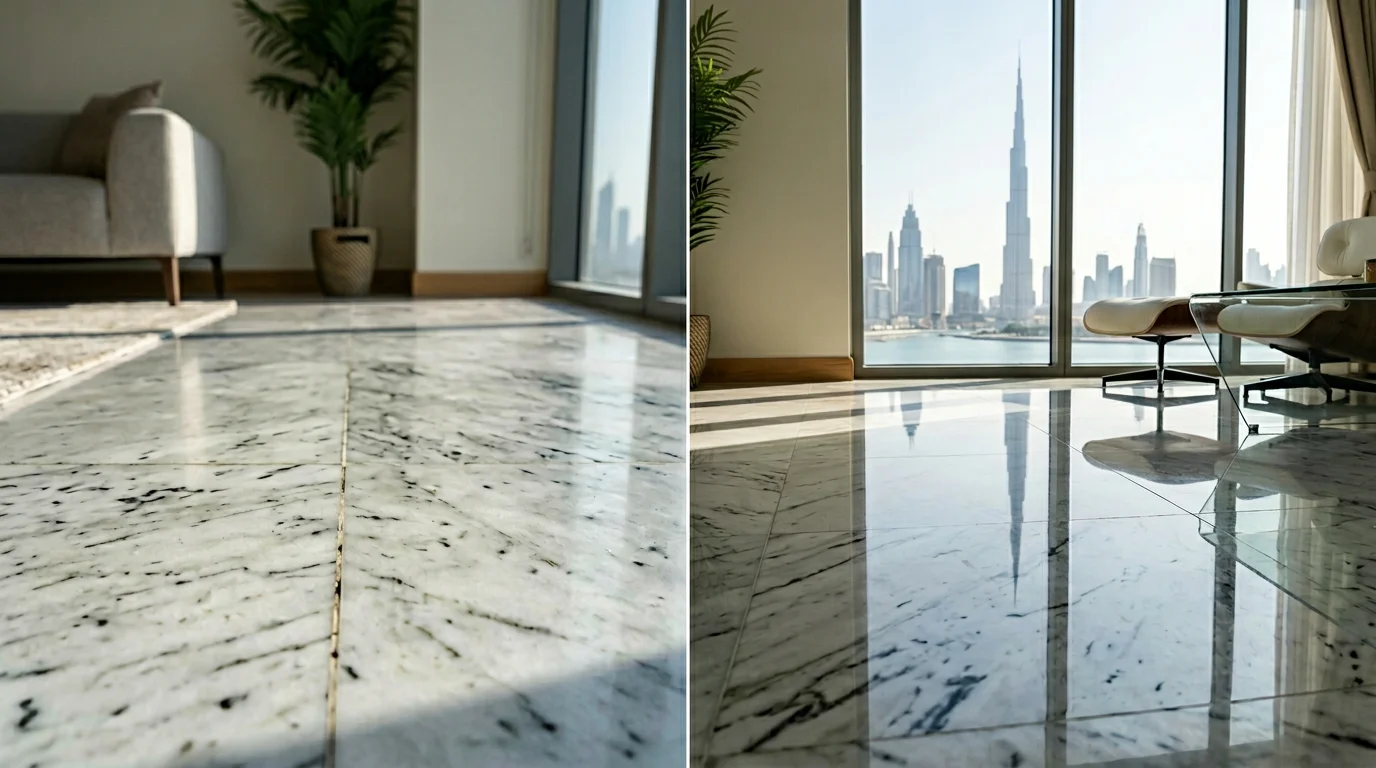
Step 5, repair the floor system. Replace cracked or missing grout, renew silicone movement joints, re-set any tiles that have come loose, and regrind and re-polish the stone where the surface has been etched or roughened.
Step 6, protect, once it is genuinely dry. A breathable impregnating sealer slows moisture movement without sealing it in. In wet zones, epoxy or high-performance grout removes the path salts travel along. Neither of these is a cure, they are the last 10 per cent.
Step 7, watch it for 6 weeks. Mark the cleaned area with tape and a date. If nothing returns, the source is closed. If a bloom reappears, there is still water in the assembly and the search continues. Do not accept “just clean it when it comes back” as a plan.
Where the water usually comes from, by location
| Where the white bloom appears | Most likely source in a Dubai property | Who you need |
|---|---|---|
| Ground-floor marble, along the perimeter of a large room | Moisture and salts from the slab, aged or missing damp-proof membrane | Waterproofing plus stone restoration |
| Bathroom floor outside the shower, and the hallway floor just beyond the door | Water escaping past the shower or tray joint and travelling in the screed | Tiler and waterproofing, not a plumber |
| Ceiling corner or bulkhead below an AC unit, with a yellow stain and a powdery edge | Blocked or wrongly routed condensate drain | AC technician first, then gypsum and paint |
| Terrace or balcony tiles, and the wall just inside the door | Ponding water, failed membrane, or a threshold detail with no upturn | Tiler and waterproofing |
| Pool deck, steps and the pool coping line | Splash, backwash and salt concentration at a wet-dry edge | Pool and tile team |
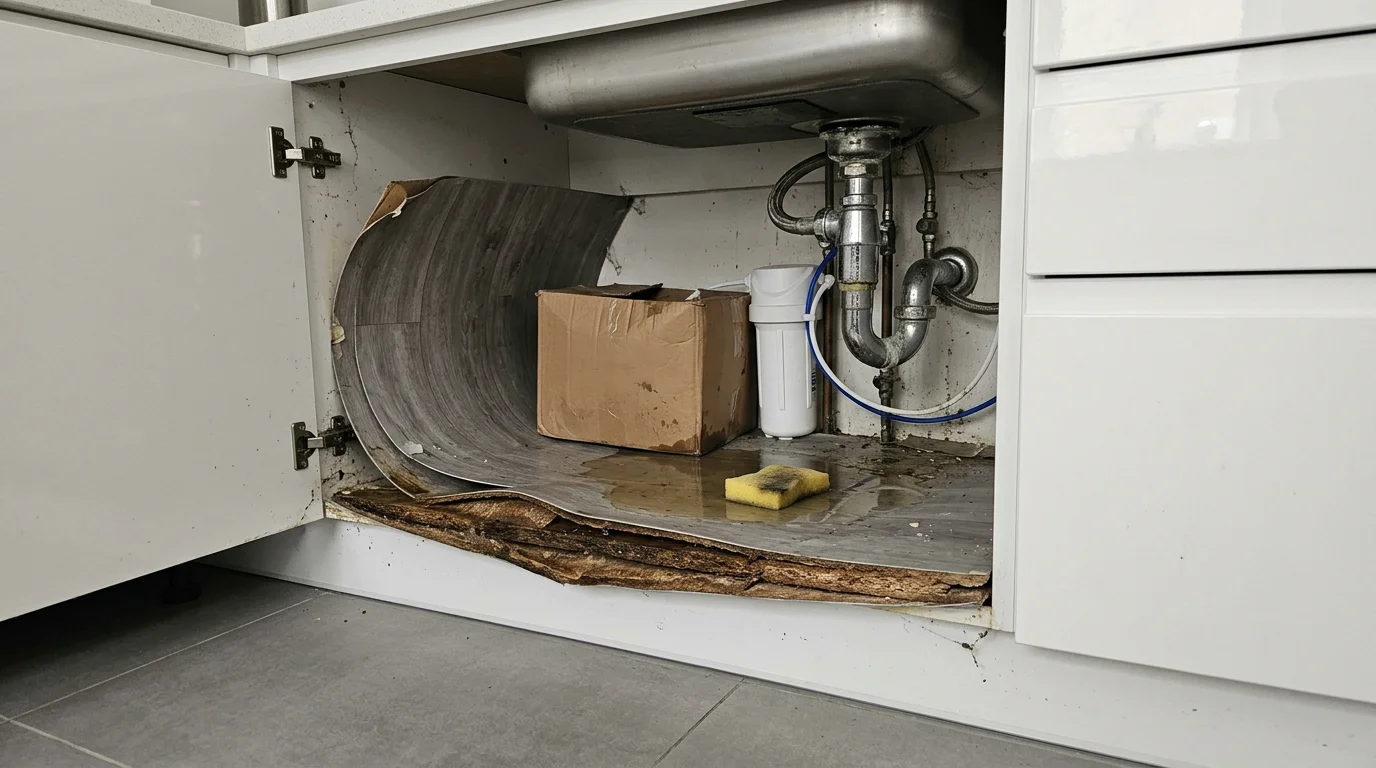
| Kitchen floor near the sink, one isolated cluster of tiles | Slow waste or mixer leak soaking the bed | Plumber, then tile repair |
| New villa, first year, faint bloom that fades | Construction moisture leaving the screed | Clean, monitor, no works |
When a white bloom stops being cosmetic
Call someone this week, rather than at the next deep clean, if any of these are true:
- The stone surface has gone rough or sugary, or a dull patch is spreading.
- Tiles sound hollow, move underfoot, or have lifted edges.
- The plaster or paint at the base of a wall is soft, blistered, or has a tide line.
- There is a stain on the ceiling of the room below the affected area.
- The smell of damp is present with the room visibly dry.
- Anything in the room has started to corrode: metal furniture legs, a door threshold, a fixed bracket. Salt-laden moisture does that, and it quietly eats through fixing anchors in a balustrade or handrail.
Frequently asked questions
Is white powder on my marble floor dangerous?
It is not a health hazard in the way mould is, but it is a symptom, not a decoration. The salts themselves are harmless to touch. The moisture behind them is what damages a building, and it is what makes floors slippery in the first place.
Will a dehumidifier fix it?
A dehumidifier helps a floor dry faster once the water source is gone, and it helps in a bathroom with a weak extract fan. It does nothing about water arriving from a slab, a leak, or a terrace, so on its own it just slows the cycle.
Why does it come back after I clean it?
Because the cleaning removed the salt and not the water. As long as moisture can travel through the screed or grout, it will keep carrying fresh salts to the surface every time it evaporates.
Can I just tile over it or lay vinyl on top?
No. Covering an active salt path traps moisture against the substrate. Vinyl and glued flooring will lift and discolour, and new tile over a wet, salty bed will debond. The floor has to be dry before anything goes on it.
Is this the same as limescale?
No, and this is the mistake that costs people their polish. Limescale is mineral left by water on top of a surface, usually from splashing, and it is dissolved with mild acid. Efflorescence is salt arriving from inside the floor or wall, and acid is the last thing you should put on marble.
My floor is new and it is doing this. Is it a defect?
Faint blooming in the first several months is normal as construction moisture leaves. A bloom that keeps returning after a year, or that comes with hollow tiles, a musty smell, or damp on a wall, is worth a written claim to whoever installed the floor.
Get the water source found, not the powder removed
If your marble or tiles keep flowering white, send us three things: a photo of the deposit in daylight, a photo of the same spot after you dry-brush it and leave it 48 hours, and a note of where the room sits in the property, which floor, which wall, and what is on the other side of that wall. That is usually enough for us to tell you whether this is drying-out, a wet-area fault, or something coming up from the slab, and who needs to be involved.
Where the answer is a wet area, a tile bed, or a stone surface that needs restoring, we handle it end to end: stone and marble restoration, tiling and tile repair, and bathroom work. Start with an inspection through our contact page, or read what clients say about how we run jobs.