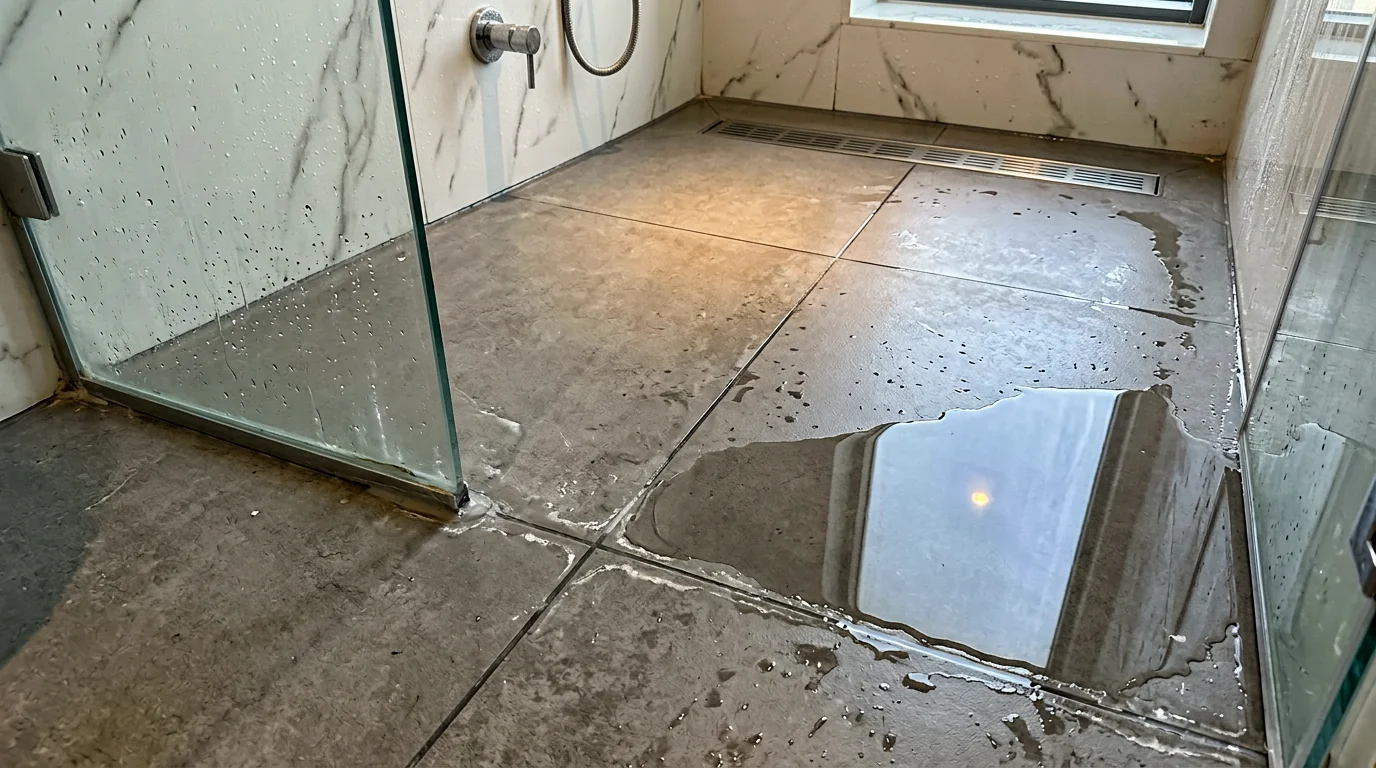
Water pooling on a shower floor looks like a small annoyance. It is one of the most common bathroom faults we get called to in Dubai, and more often than not it is not the drain’s fault at all.
You finish a shower, step out, and there is still a shallow sheet of water sitting on the floor. Not at the drain. In the corner. Or in a ring around the drain, like a bird bath. You push it toward the waste with your foot, it comes back by morning, and by the end of the week the grout in that corner has gone a shade darker than the rest.
Most people assume the drain is blocked, and pay for a drain clean. Sometimes that fixes it. Often it does not, because the drain is fine and the floor is the problem.
We re-tile shower floors across Dubai, in apartments, villas and office washrooms, and the pattern is consistent enough to write down. Here is how to tell which of the two problems you have in about a minute, what the correct fall actually is, which shortcuts are guaranteed to fail, and what a proper repair involves.
Is it the drain or the floor? Run these three tests
Do these before you call anyone, because they change the diagnosis completely.
1. The grate test (30 seconds). Lift the drain cover or the tiled insert out of the drain body. Look at the underside: hair wrapped around the strainer, soap scum sealing the slots, or a tile insert whose opening is only 8 mm of clear gap. Run the shower with the cover out. If it drains fast with no cover and slow with one, you have a drainage capacity problem at the surface, not a floor problem. This is very common with modern concealed and tiled linear drains.
2. The bucket test (5 minutes). Close the shower screen. Pour five litres of water onto the floor at the far corner, not near the drain. Watch it. Water on a correctly sloped floor travels to the drain as a moving sheet. On a flat floor it spreads, stalls, and sits. Then check the whole floor with your eyes level to the tiles, crouch down at the doorway and look across the surface: any area that reflects the ceiling light as a mirror is standing water.
3. The tape test (7 days). If you cannot tell whether it is improving, stick two short pieces of masking tape at the visible edge of the puddle and write the date on them. Photograph it. Come back in a week. A puddle that grows, or that never fully dries within about 30 minutes of a shower, is a floor-fall issue.
One more sign people miss: the grout in the low zone feels soft or powdery after a year, or one or two tiles sound hollow when you tap them with a coin. Standing water does that over time, because it never gets a chance to dry and it slowly works past the grout line.
What a shower floor fall is supposed to be
A shower floor is not level. It is a very shallow cone, or a single plane if you have a linear drain, and the drain sits at the lowest point. The numbers below are the ones we work to and the ones you can quote at a contractor.
| How it is written | Fall | What that means on a 900 mm run from wall to drain |
|---|---|---|
| 1:80 (the tight end of most wet-area standards) | 1.25% | about 11 mm of drop |
| 1:100 (often used where a shower screen or hob contains the water) | 1% | about 9 mm of drop |
| 1/4 inch per foot (the usual US tile-industry figure) | about 2% | about 18 mm of drop |
| 1/2 inch per foot (the practical maximum) | about 4% | about 36 mm of drop, which feels like standing on a slope |
Two things fall out of that table. The first is that the useful range is narrow: somewhere around 10 mm to 20 mm of total drop across a typical shower floor. That is thin enough that a lazy screed, or a tiler who laid floor tiles starting from the wall instead of from the drain, destroys it entirely. The second is that more fall is not automatically better, which is why a “just chip it and pack it up” repair can leave you with a floor you feel like you are standing on at breakfast.
If a floor was laid flat, with the drain merely flush with the tiles, no amount of cleaning will make it drain. That is a construction defect, not a maintenance problem.
Why water pooling hurts a Dubai bathroom more than most
Standing water is bad anywhere. In this city it is faster, for four reasons.
Our water is hard. Tap water here carries a lot of dissolved calcium and magnesium. Where water ponds, it evaporates rather than draining, and it leaves the minerals behind. That is why the low corner of a shower floor develops a chalky white ring on the grout that no brush fully removes, while the rest of the floor looks fine. We cover the cleaning side of that in how to remove hard water stains, but cleaning a stain you keep re-creating is a losing game.
Most Dubai bathrooms have no external sun or wind. Internal bathrooms in towers rely on a small mechanical extract fan. A shower floor that stays wet for six hours instead of 40 minutes keeps the room’s humidity high for most of the day, which is where musty smells and black mould along the silicone come from.
The AC runs continuously and the room is sealed. Cool, still, sealed air dries surfaces far more slowly than people expect, and condensation on cold tile adds to the water already there. It is the same mechanism we describe in how Dubai summer heat quietly damages your home, only in reverse.
Water goes sideways, then down. A ponded shower floor pushes water through any weak grout line, past the membrane upturn at the wall junction, and into the screed. In an apartment the screed is bonded to the slab that is somebody’s ceiling. This is how a “cosmetic” puddle turns into a damp patch on your neighbour’s ceiling, and a genuine argument about who pays.
The fixes that do not work
Everyone reaches for one of these, so it is worth being blunt about why they fail.
- More silicone around the drain or the base of the screen. Silicone is a seal, not a gradient. You cannot caulk water uphill. It also traps moisture behind it, which is how a clean-looking shower starts to smell.
- Grouting over the low spot. Adds 3 mm of powder-coloured cement that cracks within months, in the exact place where the tiles flex.
- Pouring a self-levelling epoxy or cement overlay over the existing tiles. It looks clever, and it fails for two reasons. The overlay does not bond permanently to a glazed, soap-contaminated surface, so it drums and lifts. And in a wet area you have now buried your waterproofing details, blocked the drain body, and lost floor level at the threshold. Any future leak becomes much harder to trace.
- Adding a second floor waste in the puddle. Now you have two drains, a hacked-up membrane, and a drainage point that is not connected to a properly vented stack. Some people do this. It is not a repair.
- Tiling over the existing floor to create a fall. You gain 15 to 25 mm of height, which you then take back at the door threshold, and any tile underneath that is already hollow transfers its movement straight into the new layer. It is the same reason we advise against tiling over marble in porcelain vs marble flooring in Dubai.
- Waiting. A puddle that is now 5 mm deep will not stay at 5 mm. Grout softens, a hollow tile or two appears, then the staining below the floor.
What actually fixes it
There are two honest routes, and the right one depends on how much of the floor is affected.
Route A: localised correction (one corner or one low band)
Works when the floor mostly drains and one zone holds water, and the tiles there are still solid.
- Remove the grout around the affected tiles and lift them carefully, saving any that come up clean.
- Chip out the screed in that zone and re-lay it to fall, using a straight edge run from the high point to the drain flange so the new plane actually meets the existing slope rather than creating a step.
- Re-waterproof the repaired area and carry the membrane up the wall at the junction, with a reinforcing fleece in the corner. This is the step that decides whether the repair holds.
- Let it cure fully, then flood-test the area for 24 hours before anything goes back on top.
- Re-tile, grout, and re-silicone only the movement joints.
Route B: full re-slope of the shower floor
The correct answer when the floor was laid flat, when more than a couple of tiles are hollow, or when there is already damp below.
- Strip the floor tiles and the bottom row of wall tiles, so the wall-to-floor junction can be waterproofed properly rather than butted.
- Remove the old screed back to the structural slab and check for the real cause: a drain set too high, a sunken or bridged screed, or a membrane that was never carried up.
- Set the new drain body at the correct invert height, then lay a new sloped screed to fall, checking with a level in at least four directions.
- Apply the waterproofing membrane to the fall, up the walls and over the hob, and let it cure to the manufacturer’s window, not to the schedule.
- Pond-test for 24 hours and only then tile, starting the layout from the drain so the joints stay aligned.
- Use a quality flexible adhesive, full coverage with back-buttering on large format tiles, and epoxy or high-performance grout in the wet zone if you want to stop the staining coming back.
Expect roughly 3 to 5 working days for a single shower floor on Route B, most of it waiting for cure and test. A team that promises it in one day is skipping the part that stops it leaking. If you are weighing up whether to do this during a wider renovation, we break down what changes the timeline and scope in our bathroom renovation cost guide.
What to ask for in writing before you hire anyone
Whatever company you use, ask these five questions. A contractor who does the work properly will not mind a single one.
- What fall will you lay the new screed to, in millimetres per metre?
- Will the membrane be carried up the wall and over the hob, and how far?
- Will you do a 24-hour pond test before tiling, and sign it off in writing?
- Is the drain body being reset to the correct height, or reused as is?
- What warranty covers the repair, and does it cover water reaching the space below?
If your property is newly handed over, also raise the ponding with your developer’s customer happiness team now, in writing, before the maintenance window on your handover documents closes. Flat shower floors and slow drains are common handover defects, and they are far easier to have fixed under warranty than to pay for later. Verify the exact scope and dates in your own documents, since the periods are not the same in every community.
When a puddle stops being cosmetic
Move from “someday” to “this week” if any of these are true:
- The ceiling below the bathroom shows a yellow or brown ring, or paint is bubbling at a wall corner.
- Tiles sound hollow, move underfoot, or a grout line has cracked in a shape that outlines one tile.
- The smell is still there after you have cleaned and the room has dried.
- You can see damp on a wall on the far side of the bathroom, at the base of a skirt or a doorway.
- Water is anywhere near an exhaust fan, a ceiling light, or a socket. If a fitting is wet, stop using it and treat that as an electrical hazard first. We cover the warning signs in electrical faults every Dubai homeowner should never ignore.
Book the check now, not after the ceiling stains
If water is standing in your shower, the two quick checks at the top of this page cost nothing and settle the question. After that it is a trade job, and it is the kind of job where doing it properly once is cheaper than doing it badly twice.
Send us a photo of the low area and a short video of the pour test, and we will tell you whether it is a drain, a grate, or a floor. If it is a floor, you get a written scope with the fall we are working to and the 24-hour test included. Book a bathroom inspection, or read what previous clients say about how we run jobs in our reviews.
Frequently asked questions
Why does water pool in my shower but it still drains?
Because draining and drying are different things. Water will eventually find the waste even on a badly sloped floor, but it leaves a sheet behind that never fully evaporates. The floor drains, then stays damp, and the low zone slowly discolours.
Can I fix a shower floor that doesn’t slope without removing the tiles?
Not properly. Anything you add on top of tile, grout, epoxy, a ramp, a new drain surround, changes the level at the threshold, buries the waterproofing detail, and does not bond permanently to a glazed surface. A localised tile lift and re-screed is the smallest real repair.
Is standing water in a new shower a defect?
A shower floor that is still holding water ten minutes after a normal shower is a workmanship issue on any reasonable reading of wet-area practice. Document it with a pour test and photographs, and give the installer the chance to fix it while the work is still their responsibility.
How much fall does a tiled shower floor need?
About 10 mm to 20 mm of drop from the far edge to the drain on a normal enclosure, which is roughly the 1:100 to 1:80 range most wet-area standards work to. The drain must be the lowest point, and the tile layout should start from it.
How long does a re-slope take?
Three to five working days for one shower floor, including cure and a 24-hour pond test. The tiling is the fast part. The waiting is what makes it hold.
Will re-grouting stop the puddle?
No. Grout fills gaps, it does not create a gradient. It will, however, make the floor look better for a few months while the water continues to work past the wall junction.