You mopped it yesterday. Maybe this morning. And yet there it is again, that flat, milky film sitting over your beautiful marble, like someone breathed on a mirror and it never cleared.
Here’s the thing nobody tells you: you can mop that floor every single day for a year and it will not go away.
Because it was never dirt.
I’ve spent more than a decade restoring stone floors across Dubai, Marina apartments, Palm villas, the odd hotel lobby at 2 a.m., and the cloudy-marble call is probably the one I get most. The homeowner is always slightly embarrassed, like they’ve failed at cleaning. They haven’t. They’ve just been fighting the wrong enemy with the wrong weapon.
Let me show you what’s actually happening down there.
The quick gut-check: is it dirt, or is it haze?
Try this before you read another word. Get down low, phone-on-the-floor low, and look across the marble toward a window or a lamp, so the light skims the surface at an angle.
- If you see smears, footprints, or patches that wipe away with a damp cloth, okay, that’s surface grime. Keep cleaning.
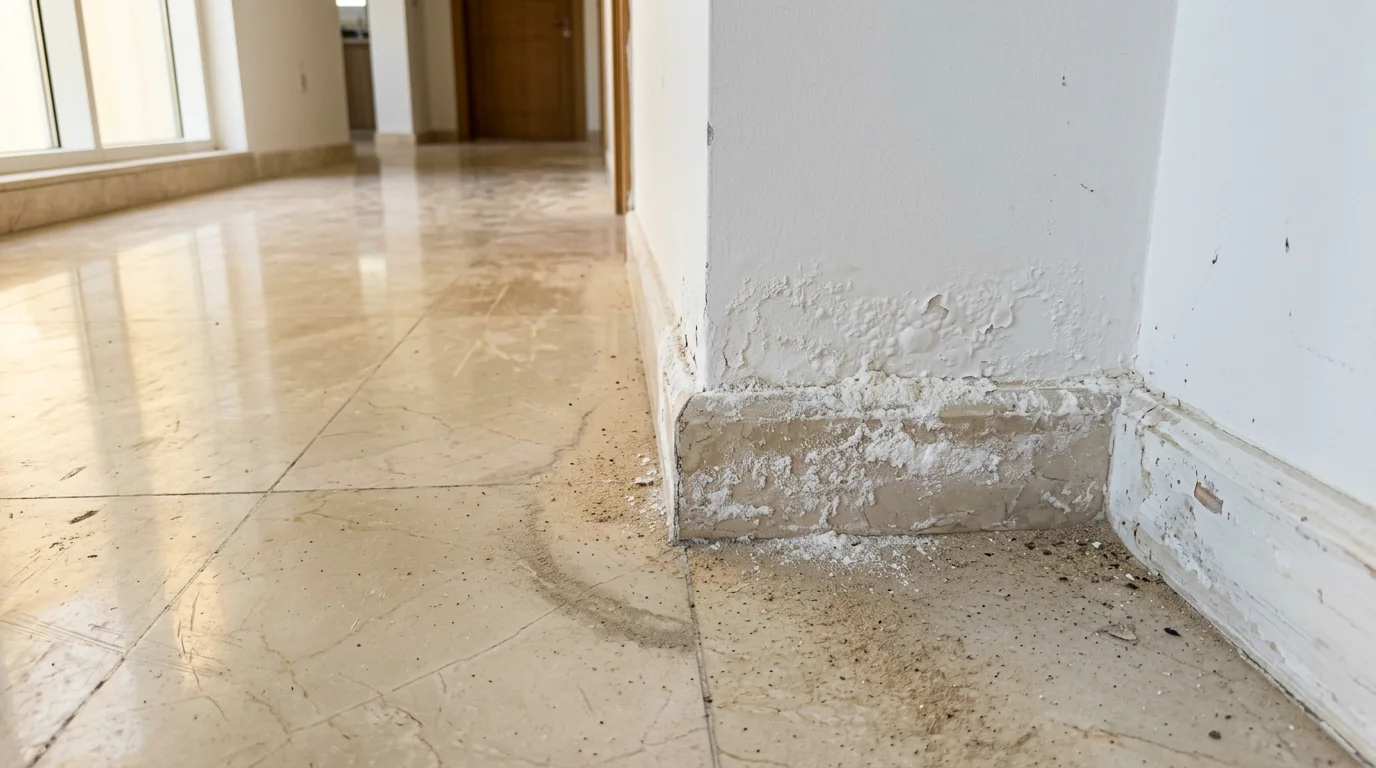
- If you see a uniform, dull fog that stays put no matter what you do, and the shine looks “asleep”, that’s the one we’re talking about.
That fog is not on top of your stone. It is your stone, slightly changed. And there are really only three things that cause it in a Dubai home.
Cause #1: Your floor has been quietly burned by acid
This is the big one. Marble is calcium carbonate, geology’s way of saying “beautiful, but chemically delicate.” Anything acidic that touches it doesn’t just sit there; it reacts, eats a microscopic bite out of the polished surface, and leaves behind a dull, etched spot. We call it etching, and it’s the number-one killer of marble shine.
The cruel part? The usual suspects are things you’d never suspect.
- That “safe, all-purpose” floor cleaner from the supermarket. Read the back, if it says anything about citrus, vinegar, lemon, or “cuts through grease,” it is mildly acidic, and you have been dissolving your floor a little more with every mop.
- A glass of orange juice from last Friday’s brunch.
- Lemon water. A splash of shampoo or a fallen bottle of toilet cleaner near the bathroom door.
- Even some “marble-friendly” sprays that aren’t.
Do this for a few months across a whole floor and you don’t get one obvious spot, you get thousands of tiny etches blending into one big cloud. That’s your haze.
The irony I see every week: the harder someone scrubs with the wrong cleaner, the cloudier their marble gets. Effort isn’t the problem. Chemistry is.
Cause #2: Hard water, and in Dubai, this is half the battle
Dubai water is hard. Mineral-heavy. Whether it’s coming through the tap or sitting in the bottom of your mop bucket, it’s loaded with dissolved calcium and magnesium. When that water dries on marble, the water leaves, but the minerals stay behind as a thin, chalky, whitish film.
One mop, you’d never notice. But you don’t mop once. You mop a thin layer of mineral deposit onto the floor, let it dry, and do it again tomorrow on top of the last one. Layer over layer over layer. After a few weeks the floor reads as permanently “dusty” or “cloudy” even seconds after it dries.
You’ll spot this version most in the high-rise apartments, the Dubai Marina crowd know exactly what I mean, because hard water plus daily mopping plus floor-to-ceiling glass (which shows every flaw in the afternoon light) is a perfect storm.
Cause #3: Old wax and “miracle shine” products that backfired
Somewhere along the way, a previous cleaner, or a hopeful YouTube video, convinced someone to pour a coat of wax, “marble polish in a bottle,” or an acrylic floor sealer over the stone to make it shine.
It works. For about three weeks.
Then it does what all those coatings do: it clouds, yellows, traps dirt underneath itself, and scuffs into a grey film that no mop on earth will lift, because the mop is sliding over a layer of degraded plastic, not touching the marble at all. Genuine stone doesn’t need a coating to shine. The shine comes from the stone itself being polished. Everything you add on top is just a future problem with a delay timer.
So why won’t mopping ever fix it?
Put the three causes side by side and the pattern jumps out:
| What you see | What it actually is | Why mopping fails |
|---|---|---|
| Dull, “asleep” patches | Etching (acid damage to the stone) | The damage is in the stone surface, not on it |
| Whitish, chalky film | Hard-water minerals | Mopping with hard water adds more of the same |
| Greyish, sticky haze | Old wax / coating breakdown | Water can’t dissolve a plastic film |
Notice what every single row has in common: the problem lives at or below the surface, and water-and-a-mop only ever works on top of it. You’re cleaning the windscreen when the fog is on the inside of the glass.
That’s not a cleaning job anymore. It’s a restoration job.
How professionals actually bring marble back
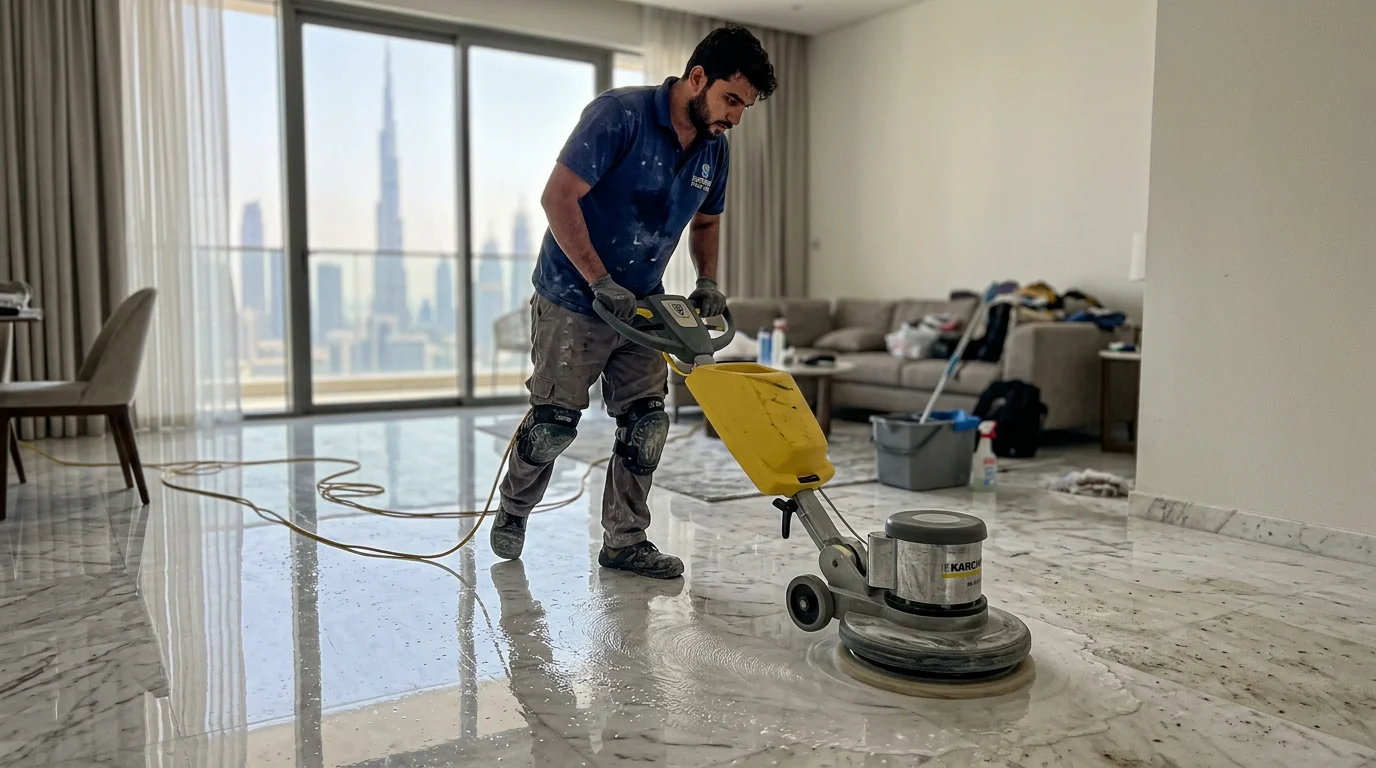
The real fix is mechanical, not chemical, and it goes by a name that sounds fancier than it is: diamond polishing, sometimes followed by crystallisation.
In plain terms, here’s the sequence we use on a Dubai floor:
- Strip everything off. Any wax, coating, or built-up mineral film is removed first, so we’re working on bare stone.
- Hone the surface flat. Using progressively finer diamond pads with a floor machine, we gently remove that whisper-thin etched and worn layer, taking the floor back to fresh, even stone underneath.
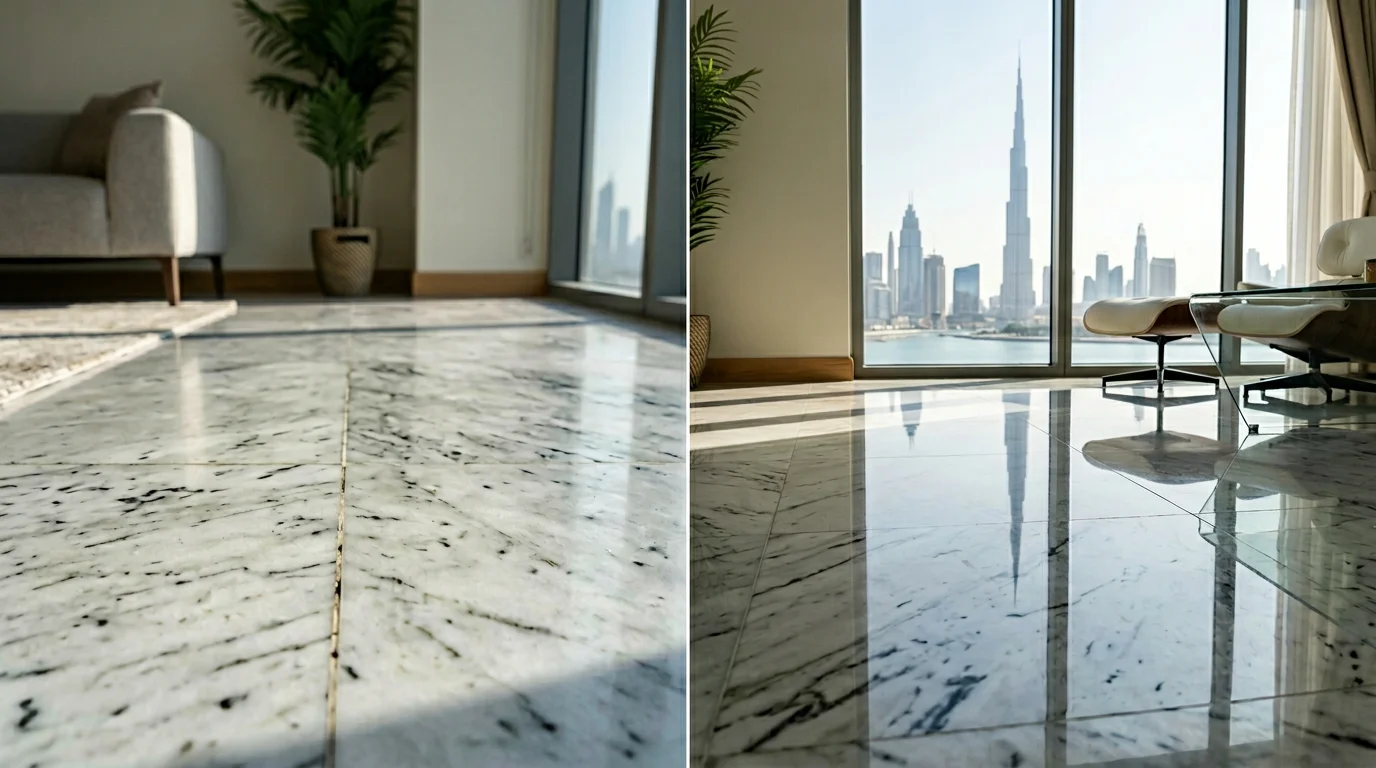
- Polish to a glass finish. Finer and finer abrasives bring the natural reflection back up. This is the moment the homeowner usually goes quiet, then says “wait, that’s what my floor looked like?”
- Seal it. A penetrating (not surface-coating) sealer soaks in and gives the stone a fighting chance against the next juice spill or hard-water mop.
It’s controlled, it’s dust-managed, and for a normal apartment it’s often done in a day. We do this all day, every day across the city, it’s the heart of our marble polishing and stone restoration service. And it pairs naturally with tile and grout work or a full bathroom refresh if the cloudiness is part of a bigger “this room feels tired” feeling.
Please, and I say this with love, don’t try to hone marble yourself with a rented machine and a YouTube tutorial. The line between “honed flat” and “permanent waves and gouges in a stone you paid a fortune for” is thinner than people think. This is one of the genuinely worth-it jobs to hand over.
Keep it clear: the Dubai marble care rules
Once your floor is restored, keeping it that way is honestly easy. The trick is doing less, not more.
- pH-neutral cleaner only. Marble-safe, neutral, no acid. If a product brags about “lemon fresh” or “cuts grease,” it’s not for your floor.
- Skip the hard tap water in the bucket. Filtered or distilled water for the final mop makes a visible difference against that chalky film.
- Blot spills immediately, especially juice, coffee, wine, perfume, and anything from the bathroom. Blot, don’t wipe-and-spread.
- Felt pads under furniture, mats at entrances. Most “scratches” are just grit being walked across the floor like sandpaper.
- A re-polish every 1-3 years depending on traffic, instead of a “deep clean” that does nothing. Prevention is far cheaper than rescue.
Quick FAQ
Is cloudy marble permanently ruined?
Almost never. Etching, mineral film, and old wax all sit in or on a thin top layer. Professional honing and polishing removes that layer and brings back the original stone underneath. True permanent damage (deep cracks, lost chunks) is a different, rarer story.
Will more expensive cleaning products fix the haze?
No, and this is the most common money-waster I see. If the cause is etching or a worn surface, no spray can rebuild stone. Cleaner only ever removes what’s on the floor. The cloud is the floor.
Can I just put a shine product or wax on it?
You can, and it’ll look great for a few weeks before it clouds and yellows worse than before. Real, lasting shine on marble comes from polishing the stone itself, then sealing it, not from a coating.
How often should marble floors be polished in Dubai?
Roughly every 1-3 years for homes, sooner for busy entrances, hallways, and anything near a kitchen or bathroom. Dubai’s hard water and fine dust speed things up compared to milder climates.
Does this apply to my bathroom and kitchen marble too?
Yes, and those rooms etch fastest because of toiletries, cleaning sprays, and food acids. They’re often the first place the cloudiness shows. A kitchen or bathroom refresh frequently starts with exactly this.
The short version
If your marble looks cloudy and the mop isn’t winning, stop blaming yourself and stop buying cleaners. You’re not looking at dirt. You’re looking at etching, hard-water film, or failing old wax , three problems that all live at the surface of the stone, where a mop simply can’t reach. The fix is a proper polish, not a harder scrub.
Get down low, catch the light across the floor, and you’ll know within five seconds which one you’re dealing with.
Seen the fog and want it gone? We bring marble back to life across Dubai every day, from Marina towers to Palm Jumeirah villas. Send a photo of your floor on WhatsApp for a free, honest assessment, book a free visit here, see what other Dubai homeowners say, or browse all our services.