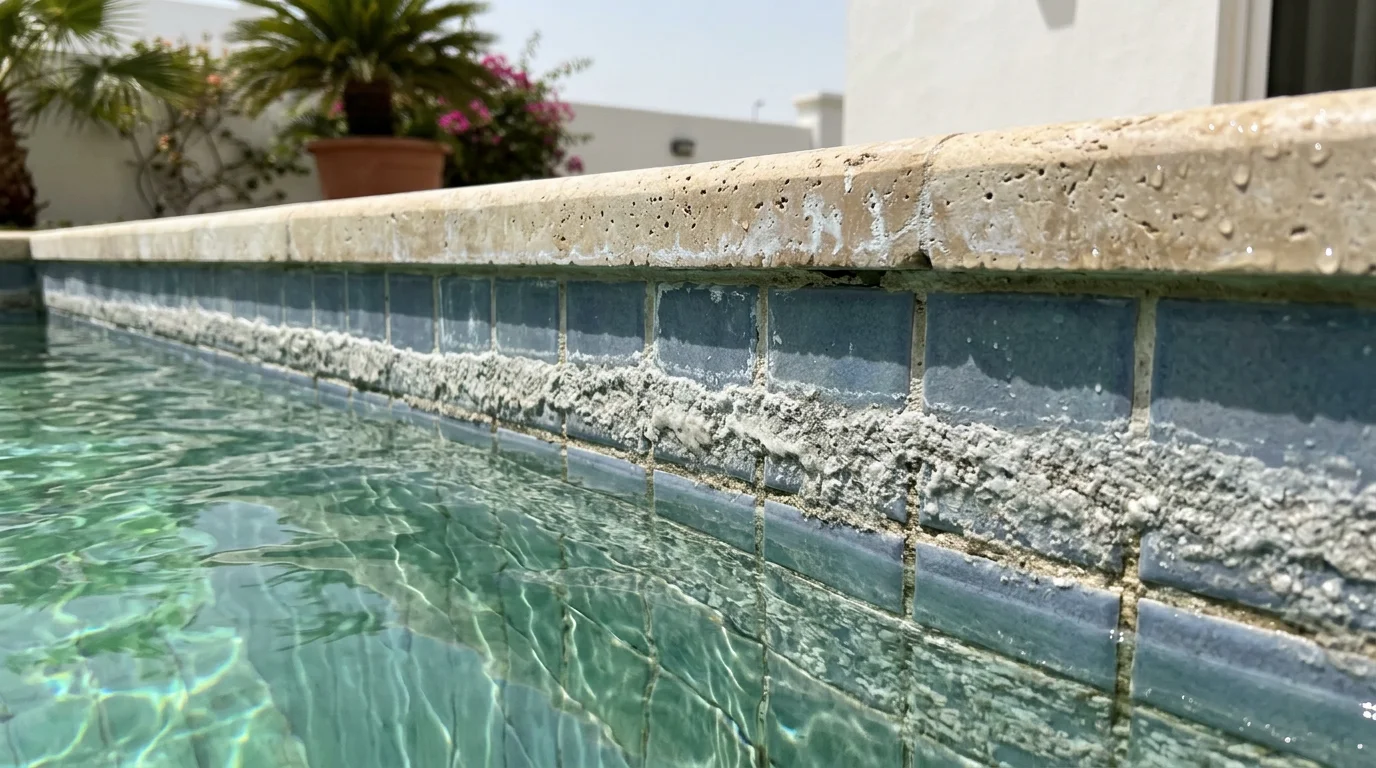
Every pool owner knows the exact spot. Ten centimetres below the top of the tiles, a pale band that never goes away. At first it brushes off. Then it does not. By the time it has gone hard and chalky, most people reach for one of two things: a stronger cleaner, or a quote for acid washing the pool.
Both are usually the wrong answer, and the second one can cost you the pool finish.
The band is mineral, not dirt, and it is a written record of your water chemistry. What matters is which mineral it is, because the two types are removed in completely different ways, and one of them is not removed with acid at all.
The two kinds of white, and the test that tells them apart
Calcium carbonate scale. White, chalky, flaky. It builds where water evaporates against a surface, so the waterline first, then ledges and steps. It is soft enough to fizz. Put a few drops of vinegar or a dilute acid on a small hidden patch: carbonate scale bubbles as it dissolves. This is the type that responds to careful acid-based cleaning.
Calcium silicate scale. Grey-white, glassy, hard, and it grows slowly. It usually comes from a pool that has run high on pH for a long time. It barely reacts to acid at all, which is why so many owners end up scrubbing a ring with a grinder pad and achieving nothing. Silicate scale is a mechanical problem: it is abraded off professionally, or the tile is replaced.
If you do nothing else from this article, do the fizz test before you buy anything. Half the money spent on pool scale in this city is spent fighting silicate with acid.
There are two other look-alikes worth ruling out:
- Dried splash deposits from a hard-water top-up or from a deck being hosed off into the pool. Same look as carbonate scale but much older layers, and it sits above the waterline where the water never reaches.
- Efflorescence on the deck and coping, which is a completely different problem arriving from behind the stone. If the white powder is on the marble around the pool and grows after the deck is washed, that is moisture moving salts, and we cover that properly in why white powder keeps appearing on your marble floor.
Why Dubai pools scale faster than pools anywhere else
Four things stack here, and none of them is your operator being careless.
Heat. Water temperature is high for most of the year, and calcium behaves the opposite way to most dissolved solids: the warmer the water, the more readily calcium falls out of solution and onto surfaces. A hot pool is a scaling pool.
Evaporation, without limit. You are not topping up a Dubai pool in July, you are topping up a Dubai pool every week in July. Every top-up adds minerals. Every litre that evaporates leaves them behind. That is the mechanism that builds a waterline band, and it is why the pool that has “never had a problem” in March is covered in one by June.
pH drift from how you sanitise. Chlorine gas, sodium hypochlorite and acid dosing all pull pH in opposite directions, and a pool held at pH 8.0 or above for a season will deposit calcium regardless of how clean it looks. This is the same pH band that determines whether your water turns green, which we set out in why your pool turns green in summer.
Splash zones that dry out and re-wet. Tanning ledges, the top step, the spa rim, a sheer-descent or spillway edge, and the shallow end of an attached spa. These cycle between wet and dry, so they get a fresh layer of concentrated minerals several times a day. That is why the ring is thickest exactly where your operator never brushes.
The numbers that stop it coming back
Cleaning treats the band. Chemistry decides whether you get another one. These are the ranges your operator should be holding, and they are the same figures we use in the algae article:
| Parameter | Target range | Why it drives scale |
|---|---|---|
| pH | 7.2 to 7.6 | Above about 7.8, calcium precipitates far more readily |
| Total alkalinity | 80 to 120 ppm | Buffers pH; high alkalinity pushes pH up and scales equipment |
| Calcium hardness | 200 to 400 ppm | Above roughly 400 ppm in a hot pool, expect a band every season |
| Free chlorine | 1.0 to 3.0 ppm | Keeps the surface slick and stops algae gripping the scale |
| Cyanuric acid | 30 to 50 ppm | Over-stabilised chlorine forces higher doses and messier pH control |
Two practical habits worth as much as the numbers: brush the waterline once a week while the deposits are still soft, and record your chemistry readings rather than only the dose your operator says they added. If you want the full routine, this is the class of item that belongs in an annual maintenance contract alongside the filter and pump checks.
How to remove it, surface by surface
This is where generic advice goes wrong, because the safe method depends entirely on what the scale is sitting on.
| Surface | Safe approach | Never do this |
|---|---|---|
| Glazed ceramic or porcelain waterline tile | Brush while wet; for a hard band, a pool-grade descaler or dilute acid on the tile face only, dwell briefly, rinse into the pool area in small sections, then retest water | Undiluted acid, letting it pool, or leaving it past the label’s dwell time |
| Glass or glossy mosaic tile | Soft brush, non-scratch pad, a dedicated glass-safe tile cleaner. Acid can dull the glaze and etch the coloured backing | Pumice, abrasive pads, wire brushes |
| Plaster or marcite finish | Regular brushing and correct chemistry. For real scale, a professional treatment; pumice only wet-on-wet and only if the finish is sound | Grinding, acid washing as routine maintenance, a pressure washer |
| Pebble or aggregate finish | Brush, then a controlled professional descale. Aggregates hide scale but the resin binder is affected by strong acid | Prolonged acid dwell, which loosens the binder and drops pebbles |
| Fibreglass or liner pools | Gentle liquid cleaner and a soft pad only | Pumice and abrasives. The gel coat is thin and it does not grow back |
| Marble, travertine or limestone coping and deck | Rinse, pH-neutral stone cleaner, mechanical cleaning by a stone professional | Acid of any kind. It etches calcium carbonate stone on contact and the loss is permanent |
The last row is the expensive one in Dubai, because so many villa pools have marble or travertine coping, a stone deck, or a stone-clad spa rim. The advice a homeowner gets from a cleaning company, “we will acid wash the tile line”, becomes a whitened, pitted, dull band of natural stone around the entire pool the moment the run-off is not controlled. Acid dissolves calcium carbonate, and marble and travertine are calcium carbonate. The same trap is why we tell people not to use vinegar on marble bathroom floors.
What an acid wash actually does to your pool
An acid wash is not a cleaning that leaves the surface untouched. It removes a thin layer of the plaster or render along with the staining, and repeated washing thins the finish unevenly. On an ageing plaster it exposes patchiness, leaves a blotchy appearance, and shortens the life of a surface you will otherwise be paying to re-render in a few years.
So the honest way to think about it: acid washing is a one-time restoration for a pool that has already been allowed to scale and stain badly, done by someone who knows how to neutralise and dispose of the acid, with the finish’s remaining life as the price. It is not an annual service, and it is definitely not a way to make tile cleaning faster.
If someone quotes you an acid wash without testing the water first, without identifying whether the deposit is carbonate or silicate, and without asking what your coping and deck are made of, you have the wrong contractor.
Two things to think about before anyone drains the pool
Villa owners are often told it is easier to drain the pool and clean it dry. Two questions first:
- Is there a hydrostatic relief in the main drain? Its whole purpose is to stop groundwater lifting an empty shell. In areas where the water table sits high, or after a wet week, draining without considering it is a real risk to the structure, not just to the finish.
- What happens to an empty shell in direct sun? A drained pool sitting in summer heat and light can crack and delaminate its finish far faster than a filled one, and any scale or stain that was in the water is now baked onto a dry surface.
Draining is sometimes the right call. It should be a decision made by whoever will be liable for the shell, not a shortcut to save scrubbing.
Safety, because acid is not a cleaning product
- Add acid to water, never water to acid, and only in a ventilated area.
- Gloves, eye protection, long sleeves. This is not the job to do in flip-flops with a child nearby.
- Never mix chlorine and acid, or chlorine and any other chemical. That is how a poolside becomes a gas hazard.
- Work in short sections, and rinse each section before moving on. Letting acid run off into the pool in volume will crash your pH and undo the cleaning you just paid for.
- Retest pH, alkalinity and calcium hardness after any acid treatment and correct them before anyone swims.
- Keep the deck wet while you rinse so run-off does not stain stone, corrode a handrail, or kill a palm.
What to ask for instead of an acid wash
If you are booking a contractor, ask these five things and their answers will tell you who has actually done this:
- Is the deposit carbonate or silicate, and how do you know?
- What is my calcium hardness, pH and total alkalinity right now, and what will you change?
- What is the waterline tile, and is anything around it natural stone?
- What product, what dwell time, and how is the run-off controlled?
- If the band will not come off without damaging the finish, what is the alternative: bead blasting, re-grouting, or replacing a row of tiles?
That last question matters more than people expect. A waterline where the grout has already gone soft is not a cleaning job, it is a tile and grout job, and scale that has been there for years has usually been helped along by water getting behind the tile. We handle the tile, grout and stone side of that here: swimming pool works, tiling and grout renewal, and stone and marble restoration. Send us your last three water tests and a photo of the band and we will tell you whether this is a chemistry fix, a cleaning job, or a repair. And if you want an outside opinion first, see what clients say.
Frequently asked questions
What is the white line on my pool tiles?
Mineral scale, mostly calcium, deposited where water evaporates against the surface. If it is white, chalky and fizzes with a drop of acid, it is calcium carbonate. If it is grey, glassy and does not react, it is calcium silicate, which does not respond to acid and has to be abraded off.
Will vinegar remove pool scale?
It will soften thin carbonate scale on glazed tile. It is far too weak for a hardened or silicate band, and it is still an acid, so it must not touch marble, travertine or limestone coping, or you will etch the stone.
Can I use a pumice stone?
Wet stone on wet tile, lightly, on plaster and glazed ceramic. Not on glass or glossy mosaic, not on fibreglass or a liner, and not on natural stone. Pumice that has picked up metal flecks from the pool shell will also leave grey streaks.
Should I acid wash my pool every year?
No. Acid washing removes a layer of the finish along with the staining, and repeating it thins and blotches the surface. It is a one-off restoration for severe scaling, not maintenance, and it should follow a chemistry test rather than replace one.
Why does the scale come back weeks after cleaning?
Because the water is still oversaturated. Cleaning removes the deposit; only bringing pH, alkalinity and calcium hardness back into range stops the next one. In a hot climate with weekly top-ups, that often also means a scale inhibitor and a partial water replacement plan.
Is scale the same as algae?
No. Scale is a hard, rough mineral deposit and brushing does nothing to it. Algae is biological, feels slippery, and responds to shock and brushing. A pool can have both at once, with a green film sitting on top of a white band, which is why a green pool that comes back after treatment needs its chemistry tested rather than dosed again.