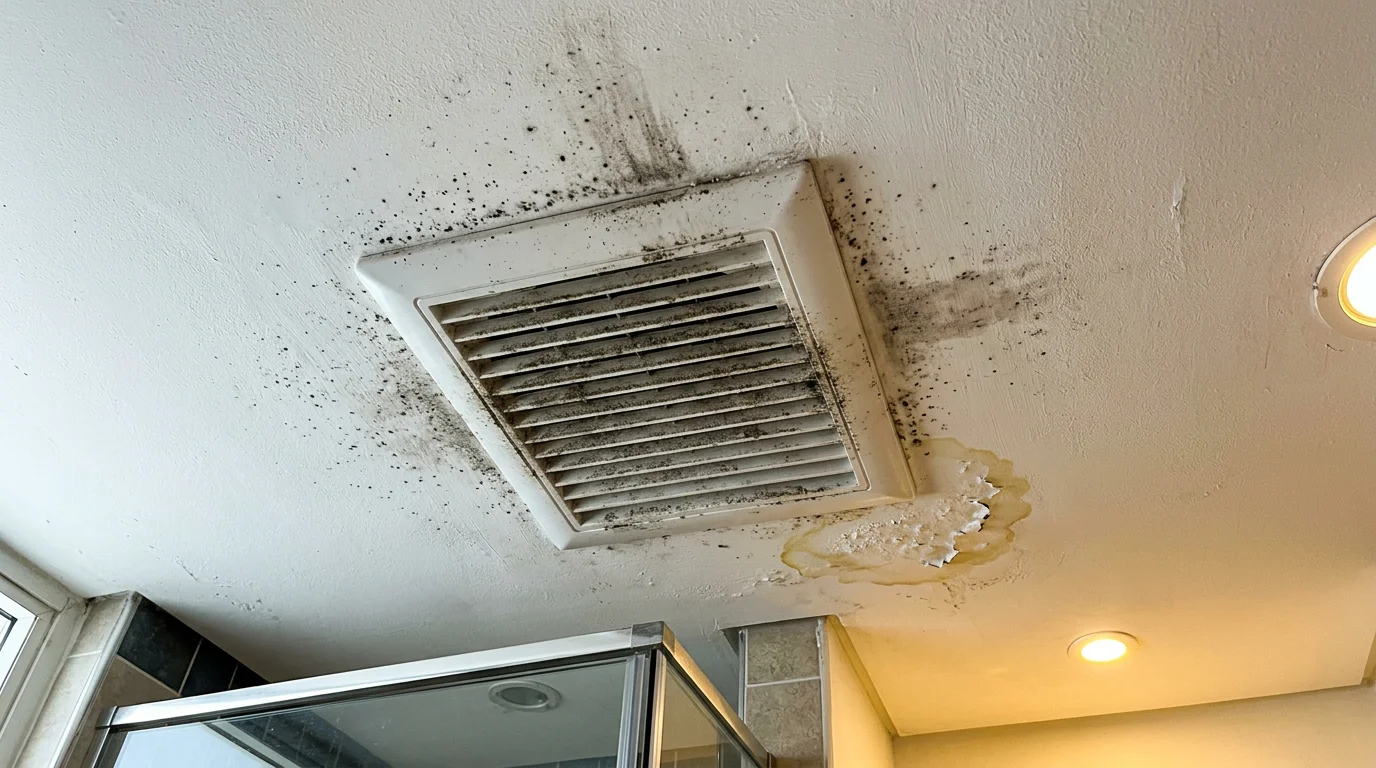
You run the fan every shower, the timer keeps it running for half an hour, and the mirror is still wet when you go back in. Or worse: the fan is loud, the ceiling around the grille has gone grey with mould, and the paint above the shower is starting to bubble.
The usual conclusion is that the fan is weak, so people buy a stronger one, fit it in the same place, and the damp comes back. We open a lot of these ceilings, and the reason is usually much simpler. The fan is moving air exactly where it was installed, and where it was installed is the ceiling void, not outside the building.
Where your bathroom air is actually going
Lift the grille off its clips. It usually hangs on two springs or four screws, and it takes a minute. Look at what the fan is attached to.
- A duct with a collar at one end and a wall or roof terminal at the other. This is the correct setup. Follow the duct to where it terminates and check that the terminal is not painted over, blocked by insulation, or fitted without a backdraft flap.
- A short duct that stops inside the ceiling void. Very common. The fan is exhausting your shower into the space above the bathroom ceiling.
- Nothing at all. An open hole, or a fan mounted to a blank box. Also common in a bathroom where the fan was replaced by a handyman and nobody chased the duct.
- A duct into a soffit or a roof tile that has since been blocked with insulation or bird-proofing mesh. The fan seems to work, because the air has somewhere to go. It is just not going far enough.
Now the part that matters specifically in Dubai. In many villas and tower apartments the ceiling void is not an empty space at all. It carries the fan coil unit, the ductwork, and in a lot of systems the void itself is used as the return air path. Which means a bathroom fan dumping moist air into the void is feeding that moisture into the air handling system, and it is being pulled across a cold coil. The result is not just a damp ceiling. It is a musty smell at the AC grilles in every room nearby, and staining on the gypsum board that keeps coming back after it is repainted.
If your bathroom smells musty, the mirror stays wet, and there is a faint tide mark around the ceiling grille, you are not looking at a cleaning problem.
Four checks before you spend anything
1. The paper test. Turn the fan on and hold two sheets of toilet paper flat against the grille. A fan doing its job holds them there. If they slide off or only flutter, the fan is not pulling. This does not prove where the air goes, but it proves whether anything is moving.
2. The timing test. After a shower, leave the fan running and time how long the mirror takes to dry with the door closed. Over about 20 minutes, you have no extraction. The benchmark to aim for is not a feeling but a rate: UK building guidance sets a minimum intermittent bathroom extract of roughly 15 litres per second, about 54 cubic metres an hour. Most small builder-grade fans behind a 100 mm duct are well under that, and Dubai has no published equivalent, which is exactly why so many of them are installed.
3. The gap under the door. This is the one everybody misses. An extractor can only remove air that can replace it. If your bathroom door is fitted tight to the floor with no undercut, and the room has no window and no transfer grille, the fan is trying to pull against a sealed box. Open the door a crack and run the fan. If the noise changes and the mirror dries faster, your problem was never the fan. The fix is a 10 to 15 mm gap under the door, or a cut-through grille in the door, which is a carpentry job rather than an electrical one.
4. The drip. If water drops from the grille when the fan runs, the warm moist air is condensing inside a cold duct on its way out. That is not a cracked fan. It is an uninsulated duct crossing a cold ceiling void, sometimes a duct with a dip in it where water collects. Insulating the run, correcting the fall so it drains toward the outside terminal, and using a smooth-bore duct the same size or one larger than the fan outlet is the actual repair.
What fixes each of these
| What you found | The real fix | What it does not fix |
|---|---|---|
| Fan blows into the ceiling void | Re-route to a proper external terminal, with a backdraft flap | A new, stronger fan in the same hole |
| No duct at all | Install duct and terminal. Where the void is a return path, this is not optional | Air fresheners, mould spray, a dehumidifier running constantly |
| Duct too long, too small, or kinked | Shorter run, larger smooth duct, minimum tight bends, sealed joints | Increasing fan speed on a blocked run |
| Fan cannot pull because the room is sealed | Undercut the door or fit a transfer grille, then retest | Replacing the fan unit |
| Fan is undersized and the duct is fine | Upsize to a humidistat-controlled unit rated near the airflow benchmark | Running a weak fan for longer |
| Water drips from the grille | Insulate and correct the fall of the duct, add a small drip loop at the terminal | Replacing the fan motor |
| Grille and duct full of dust | Clean both, check the flap moves freely | Nothing else, do this first |
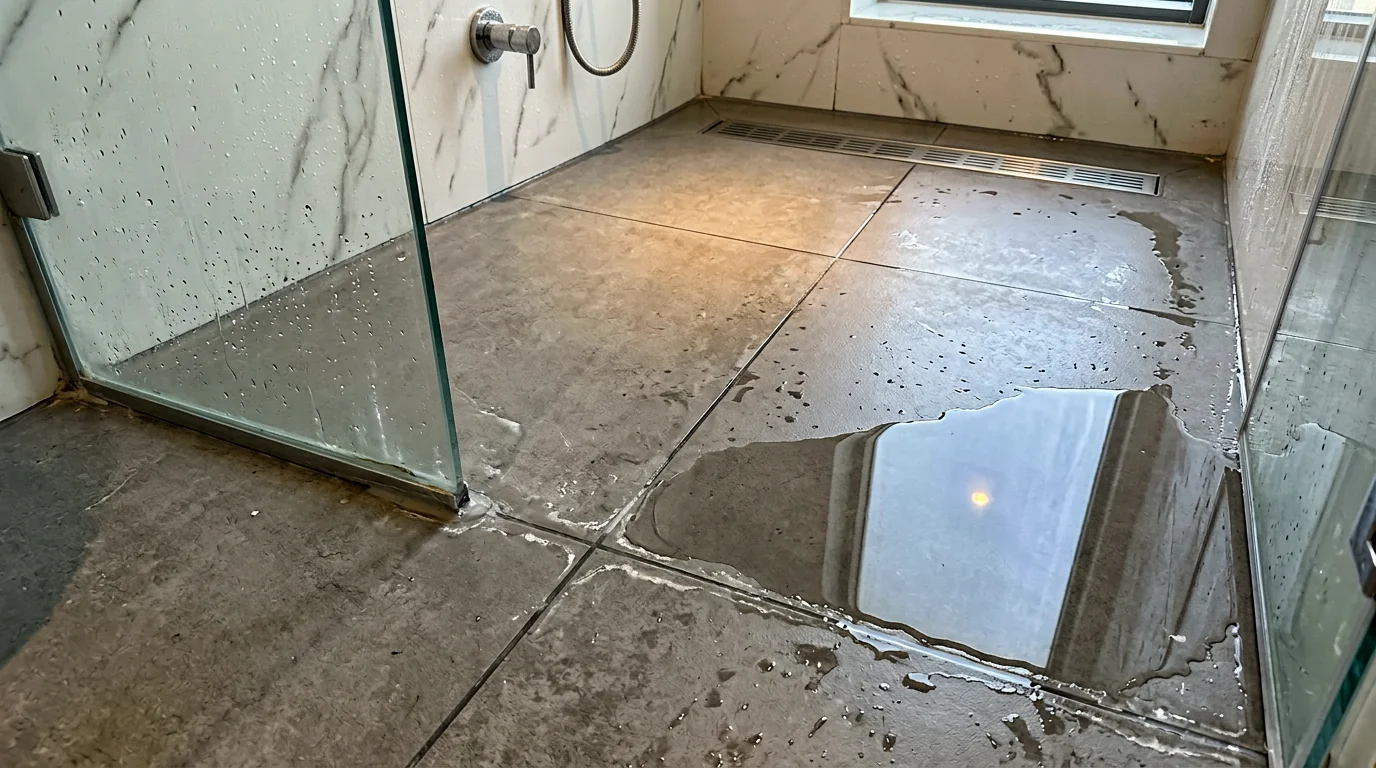
Two things worth naming plainly. A humidistat is worth more than extra power, because it runs when there is moisture rather than when someone remembers to switch it on. And if the ceiling board above a bathroom is soft or stained, the fan fix and the ceiling fix are two jobs for two trades. We deal with the ceiling side in why white powder keeps appearing on your marble floor, and the water that ends up under tiles in water pooling in your shower floor.
The habits that cost nothing
- Leave the fan running for at least 20 minutes after a shower, not five. A timer switch does this better than willpower.
- Wipe the mirror and the shower screen after use. On our water that also slows the mineral film we cover in how to remove hard water stains in Dubai.
- Do not dry washing in a bathroom with the door shut and no extraction. It is the fastest way to make a wall damp in a property that never sees rain.
- Keep the grille clean. A dust-caked grille loses a large part of its capacity, and this takes ten minutes.
- Do not tape or block a wall vent or transfer grille to stop a draught.
- If the fan has a pull-cord that nobody uses, fit a timer or a humidistat instead of buying a bigger fan.
When to call someone
Bring in an electrician or a maintenance contractor when:
- The fan is inside the ceiling with no visible duct and no accessible terminal.
- The mould keeps returning within weeks of cleaning, which means the moisture is still there.
- There is staining or a soft patch on the ceiling, or water marks on the wall on the other side of that wall.
- The fan has stopped entirely and resetting the breaker does not bring it back. Do not keep re-tripping it.
- You need a new external terminal cut into a façade, a soffit or a roof. In a tower or a villa community that is a building-work matter, not a DIY afternoon, and the work should be done by a licensed contractor.
We handle the whole chain here: fan replacement and rewiring, duct and terminal installation, ceiling board repair and finishing, and the door undercut that makes it all work. Electrical work, gypsum and ceiling repairs, carpentry and bathroom works sit under one team, which matters on a job like this. Book an inspection, or read what clients say about how we run jobs. If you want this checked on a schedule rather than after the smell appears, it is exactly the kind of item that belongs in an annual maintenance contract.
Frequently asked questions
Should a bathroom fan vent into the ceiling void or outside?
Outside, through a wall or roof terminal with a backdraft flap. Venting into a void just moves the moisture to somewhere you cannot see, where it condenses on cold surfaces and feeds mould in the ceiling, the insulation and the air handling system.
How do I know if my bathroom fan is actually working?
Hold two sheets of toilet paper against the grille with the fan running. It should hold them flat. Then time how long a steamed mirror takes to clear with the door closed. Longer than about 20 minutes means the room is not being exchanged properly, even if the fan sounds busy.
Why is my bathroom always humid in Dubai even with the AC on?
Because the AC cools the room but does not remove what the shower adds if the moisture is being dumped into the ceiling instead of out of the building. In a sealed apartment with an internal bathroom, extraction is the only drying mechanism you have.
My ceiling around the fan is brown and stained. Is that a leak?
Not necessarily. It is usually condensation dripping back from a cold duct or from air that has no way out. Check the fan before you assume the neighbour above you has a leak, and check both if the stain grows only when the bathroom is used.
Do I need a bigger fan or a longer run time?
Fix the path first, then look at size. A correctly ducted fan that runs on a humidistat usually beats a powerful fan fighting a 6 m kinked flexible duct and a sealed door.
Is mould from a bad bathroom fan dangerous?
The damp itself is the problem for the building, and mould growth on damp surfaces can aggravate asthma, allergies and respiratory irritation. It is the reason not to tolerate a fan that “kind of works”. EPA guidance on mould is clear that the answer is moisture control, not cleaning.