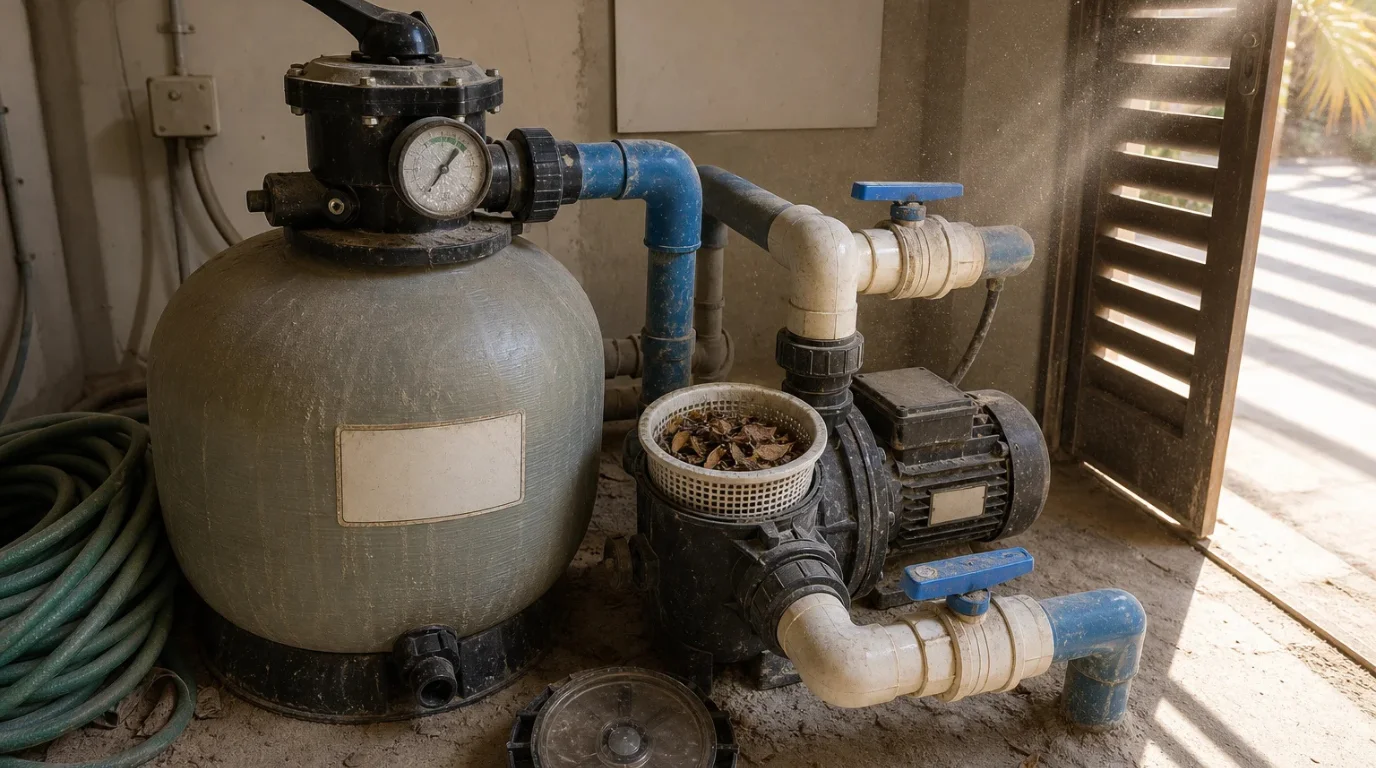
Every sand filter has a pressure gauge, and in most Dubai villas nobody reads it. The operator comes weekly, throws the valve to backwash because that is the routine, runs it for eight minutes because they are on site anyway, skims the baskets, and leaves. The water is clear, so nobody asks.
That habit costs you hundreds of litres of water every visit, shortens the life of your filter media, and hides the single most useful diagnostic you own. Backwashing is not a calendar event. It is a response to a number.
How a sand filter actually gets dirty
Water is pushed down through a bed of graded silica sand. Dirt is trapped between the grains, which is the point: a filter that is slightly dirty filters better than a freshly cleaned one, because the trapped material is catching finer particles. As the bed loads up, resistance rises, the gauge climbs, and flow out of your return jets drops.
Backwashing reverses the flow, lifts the bed, and flushes the trapped material to waste. Do it too often and you strip out that fine filtration, waste water, and add chemicals to replace what you threw away. Do it too late and the pump works against rising resistance, flow falls, and a heavy enough load can push dirt through the bed or channel it, permanently reducing what the filter does.
So the correct answer is neither “weekly” nor “when the water looks cloudy”. It is: when the gauge says so.
Establish your baseline in five minutes
Do this on the next visit, and write the number on a card zip-tied to the pump.
- Backwash properly (steps below) and then rinse.
- Return the valve to Filter, with the pump off, then start the pump.
- Let it run for a couple of minutes and read the gauge. That figure, typically somewhere in the region of 8 to 15 psi on a clean residential system, is your clean baseline.
- Write it down with today’s date, the pool’s water level, and whether anything was running (cleaner, spa, waterfall).
From then on, the rule is simple: backwash at 8 to 10 psi above that baseline, not before. Anything above about 10 psi over baseline means the bed needs a clean now. A reading that never comes back down after a full backwash and rinse is a different problem, and it is covered below.
Three things that invalidate a baseline, so record them too: how many pumps and features are on that circuit, whether a pool cleaner is connected to the skimmer, and whether the water level is at the middle of the skimmer opening. A low water level lets the pump draw air, and a gauge cannot tell truth from an air-locked pump.
Correct backwash sequence, including the two skipped steps
- Turn the pump off. Moving a multiport valve while the pump is running is the fastest way to shred the spider gasket inside it. This is the most expensive avoidable repair in a residential plant room.
- Turn the valve to Backwash.
- Start the pump. Watch the sight glass. Run until the water in it runs clear, usually 2 to 3 minutes. Not 8 minutes, and not “a bit longer to be sure”.
- Stop the pump. Turn the valve to Rinse.
- Run the rinse for 30 to 60 seconds. This is the step everybody skips, and it is the reason some pools go cloudy an hour after a backwash. The rinse settles the bed and flushes the loose dirt still sitting in the laterals out to waste instead of into the pool.
- Stop the pump, return to Filter, restart.
- Read the gauge. It should now sit near your baseline. If it is still 5 psi or more above it, the problem is not dirt in the bed.
- Check the water level. A backwash drops it, and a pool that runs below the skimmer draws air and burns a pump seal.
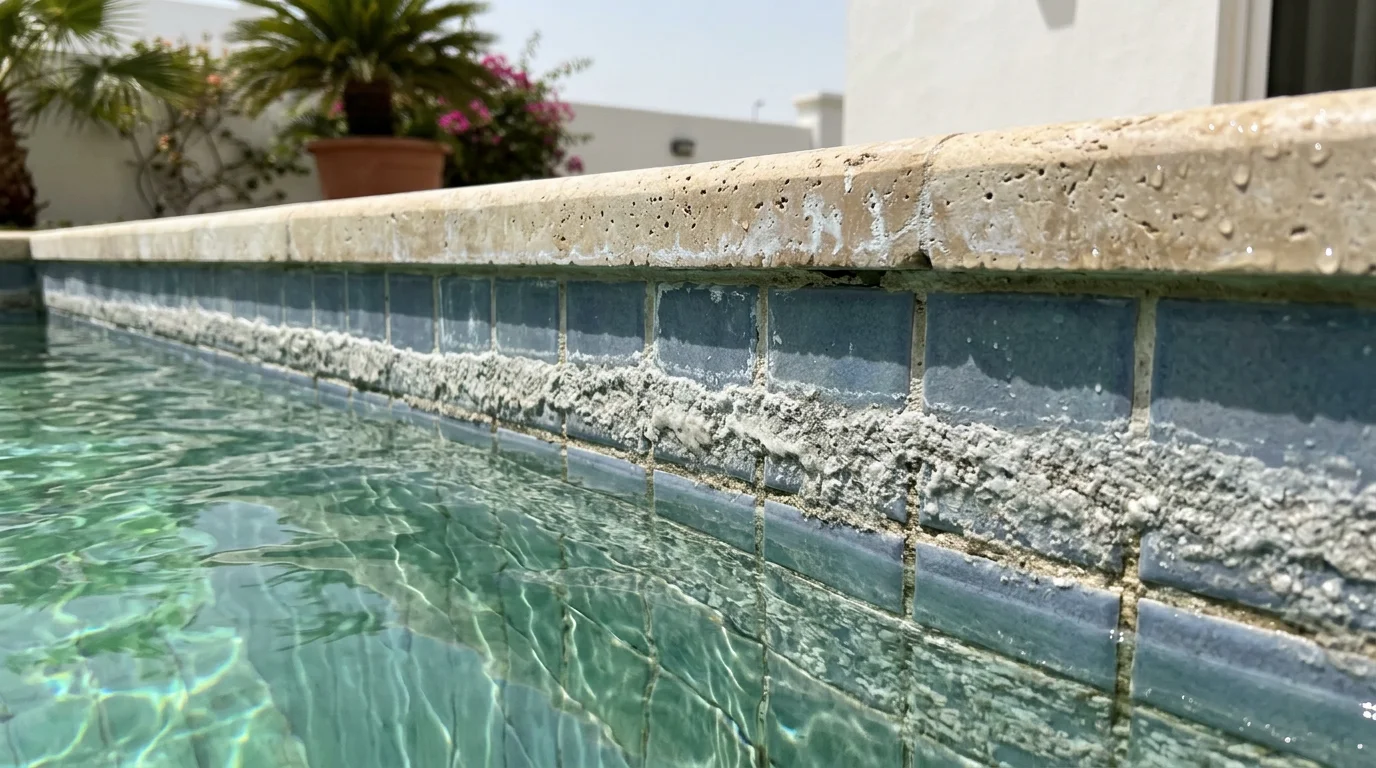
Top up afterwards, and retest chemistry if you have replaced more than a couple of cubic metres. Fresh make-up water in this city comes in warm and mineral-heavy, which is exactly the combination that leaves a scale line on your tiles. We cover that in the white ring on your pool tiles.
What the gauge reading is telling you
| What the gauge does | What it usually means | What to do |
|---|---|---|
| Reads near baseline, water still cloudy | Not a filter problem: chemistry, dead algae, or circulation time | Check chlorine and pH, run the pump longer, brush |
| Rises steadily over 1 to 2 weeks | Normal loading with this much dust and bather load | Backwash at baseline plus 8 to 10 psi |
| Climbs within a day or two of a backwash | Something is overwhelming the bed: algae, pollen, a dead insect load, a dirty pump basket, or a cleaner dumping debris | Fix the source; do not backwash repeatedly |
| Stays high after a proper backwash and rinse | Compacted or greasy media, channelling, a partially closed valve, or a blocked return line | Inspect the sand, check valves are fully open, consider media change |
| Reads lower than usual and flow is weak | Air being drawn in, low water level, clogged pump strainer, or a skimmer basket blocking | Raise the water level, clean baskets, check lid seal and valve on the pump |
| Needle bouncing, fogged face, or stuck | A failed gauge, which is a cheap part you are flying blind without | Replace it. Do not skip this |
| Same reading whatever the pump does | Gauge or its line is blocked or broken | Replace the gauge |
That last row is the honest reason most villa owners have no idea what their system is doing: the gauge stopped working years ago and nobody replaced it because the plant room is not a place anyone looks at.
Why over-backwashing is worse than it sounds here
Water. A single backwash sends several hundred litres to waste in minutes, and a weekly habit in a household that does not need it runs into tens of cubic metres over a season. In a city that has to desalinate every litre, and in communities with rules about water use and about discharge, that is not a neutral choice.
Chemicals and money. Every cubic metre you throw away takes its chlorine and stabiliser with it, so you dose more, and you spend more on make-up water.
Your sand. Backwashing is an abrasive event. The grains knock against each other, and their sharp edges, which are what makes them filter, wear round. Excessive cycles age media faster than normal use does.
Filtration quality. As covered above, a bone-clean bed lets fine particles pass. If your water looks flat and lifeless despite balanced chemistry, the culprit is often a filter that has been backwashed too often.
Your garden and paving. Backwash water is not clean water. It carries chlorine, dissolved solids and whatever was in the bed. Feeding it onto a planted bed year after year stresses turf and palms and leaves mineral staining on stone. If the waste line runs onto paving rather than a drain, expect the pale crust we explain in why white powder keeps appearing on your marble floor to appear wherever that water sheet-dries. The wet-dry edge between the deck paving and the pool shell is a movement joint like any other corner, and why grout cracks in wet corners is the same problem at pool scale. Low-voltage garden lighting buried in that same bed fails faster for the same reason, which is covered in why your garden lights work again after the rain.
The pressure reading also tells you when the bed is being asked to do too much because of the season. That summer dust load is the same force we describe across the building in how Dubai summer heat quietly damages your home.
How to make the whole system need less backwashing
- Skim the surface and brush weekly. Debris you remove with a net never reaches the bed.
- Clean the pump strainer and skimmer baskets weekly, and more in a windy week. A partly blocked basket makes the pump work harder and pushes dirt through when you finally open it.
- Shock and brush after a party, a storm or a heavy pollen day, then backwash once instead of running the filter continuously to chase the load.
- Keep chemistry in range. Algae is the number one cause of a filter that will not stay clean, and chasing it with the filter alone is a losing argument. pH 7.2 to 7.6, free chlorine 1.0 to 3.0 ppm and total alkalinity 80 to 120 ppm are the numbers, and they are the same ones in why your pool turns green in summer.
- Run the pump long enough, not harder. Longer filtration at normal flow cleans water; higher flow through a loaded bed does not.
- Use a pre-filter or leaf canister on trees-heavy plots, if the property drops a lot of organic matter.
- Cover the pool when it is not being used. It reduces evaporation, and in this climate that is the biggest lever on both water top-ups and mineral load. The dust and heat that load the bed in the first place are the same seasonal forces catalogued in how Dubai summer heat quietly damages your home.
- Keep a log. Date, psi before, psi after, minutes backwashed, water level. Three months of it tells you more about your pool than any operator’s opinion. Ask your operator to fill it in; a company that has never seen a gauge is telling you something about the service.
Media itself does eventually need replacing. Sources in the industry put it anywhere from three to seven years depending on the sand grade, the bather load and whether oils from sunscreen and lotions have glued the grains together. Use your media data sheet and let the pressure symptoms decide, since channelling, a permanently high reading, or clarity that no longer survives a backwash are the real signals.
When to call someone
Bring in a pool technician when:
- The pressure stays high after a correct backwash and rinse.
- Sand or media is appearing in the pool returns, which points to a broken lateral or a failing filter.
- Multiport valve leakage from the waste line while filtering, usually the spider gasket.
- The pump has lost prime, runs loud, or the motor housing is hot.
- You want the whole circuit properly commissioned and a baseline recorded, which is a one-visit job and changes how the pool behaves for years.
- Algae keeps returning despite balanced chemistry, which is usually a circulation and runtime problem, not a chlorine problem.
We do the plant-room end of pool upkeep with the same records discipline we use on any other asset, and we can coordinate it under one visit with the tile, stone and deck work around the pool: swimming pool services and stone and marble for the deck and coping. If the property is being handed back at the end of a lease, a plant room with a fogged gauge and a full basket is a visible condition item, and the move-out walkthrough lists where it sits. If your pool is on a maintenance contract, this is the section to hand your operator. See what an annual maintenance contract actually includes in Dubai, or request a plant-room review.
Frequently asked questions
How often should I backwash a sand filter?
When the pressure gauge reads 8 to 10 psi above your clean baseline, which in a dusty Dubai summer might be every week or two and in a quiet covered winter might be a month or more. A fixed weekly schedule wastes water, shortens media life and reduces how fine the filtration is.
Should I backwash after every storm or pool party?
Usually yes, one cycle after the event rather than weekly forever. A heavy debris load or a big bather load pushes the pressure up quickly, and one full backwash and rinse at that point protects both clarity and the bed.
My pressure is high and a backwash didn’t fix it. What now?
Three likely answers. The sand has compacted or is coated with oils and needs replacing. The multiport or a valve is not fully open. Or the blockage is downstream of the filter, in the returns, the cleaner line or a partly closed isolation valve. This is a diagnostic visit rather than another backwash.
How long should a backwash run?
Until the sight glass runs clear, which on most residential pools is two to three minutes. Longer is only waste: more water, more chemical loss, more abrasive wear on the sand.
Do I really have to rinse after backwashing?
Yes, 30 to 60 seconds. The rinse re-settles the bed and flushes remaining dirt to waste. Skipping it sends that dirt into the pool, and it is the most common cause of cloudy water immediately after maintenance.
Can I service the filter myself?
Reading the gauge, cleaning baskets, checking the water level and running a backwash cycle are all reasonable owner tasks once an operator has shown you your specific system. Replacing the gauge is trivial. Anything involving opening the filter vessel, working on the valve internals, the electrical supply or the media is not.