Outdoor electrics in Dubai fail in a way that looks like a ghost. A string of path lights cuts out after a wet night, comes back on its own three days later, and nobody can explain it. Or worse, the whole outdoor circuit starts tripping the residual current device in the villa’s sub-board every time the sprinklers run, and the fix everyone proposes is to keep resetting it.
There is always a physical reason. In this climate it is nearly one of three things: the fitting is not rated for where it is installed, the cable or its connections are being destroyed by the sun and the irrigation, or water is entering somewhere a dry indoor electrician would never think to look.
What the IP rating on a fitting actually means
Every outdoor fitting carries an ingress protection code, two digits. The first is solids and dust, the second is water. Most people read the second number and stop, and both matter here.
| Location | Realistic minimum | Why |
|---|---|---|
| Covered porch or a soffit light out of direct rain | IP44 | Splash only, but still needs a 30 mA device protecting the circuit |
| Exposed wall light, floodlight, security light | IP65 | Wind-driven rain is a jet, not a spray |
| Ground-level spike and well lights in a planted bed | IP65 to IP67 | They get hosed, flooded and buried in mulch |
| Any fitting within splash range of a pool, fountain or waterfall | IP67 or better, plus correct zoning | Repeated wetting, chemicals, spray pressure and the mineral film described in the white ring on your pool tiles |
| Outdoor socket | IP66 to IP67 with a closed, hinged cover | An open “weatherproof” socket is not weatherproof |
| An in-ground deck light on a terrace | IP67 or IP68 as installed, sealed gland, no water trap | It sits in a pocket that fills with rain |
Two things the table is telling you. A fitting that was fine under a pergola will fail in nine months once a pergola is enclosed and wind drives water at it. And an IP rating is a statement about the fitting as delivered, not as installed: the same IP65 lantern fails immediately if the cable entry points up, if the gland is the wrong size, or if the knockout is left unsealed.
A rating also has a shelf life. Gaskets harden and shrink in ultraviolet light and heat, drain holes clog with sand, and the seal around a glass lens fails long before the fitting looks damaged. Anything outdoor in this country is being aged faster than the same fitting in Europe. That accelerated ageing is the same mechanism described across other building materials in how Dubai summer heat quietly damages your home.
The four failures we find most often in Dubai gardens
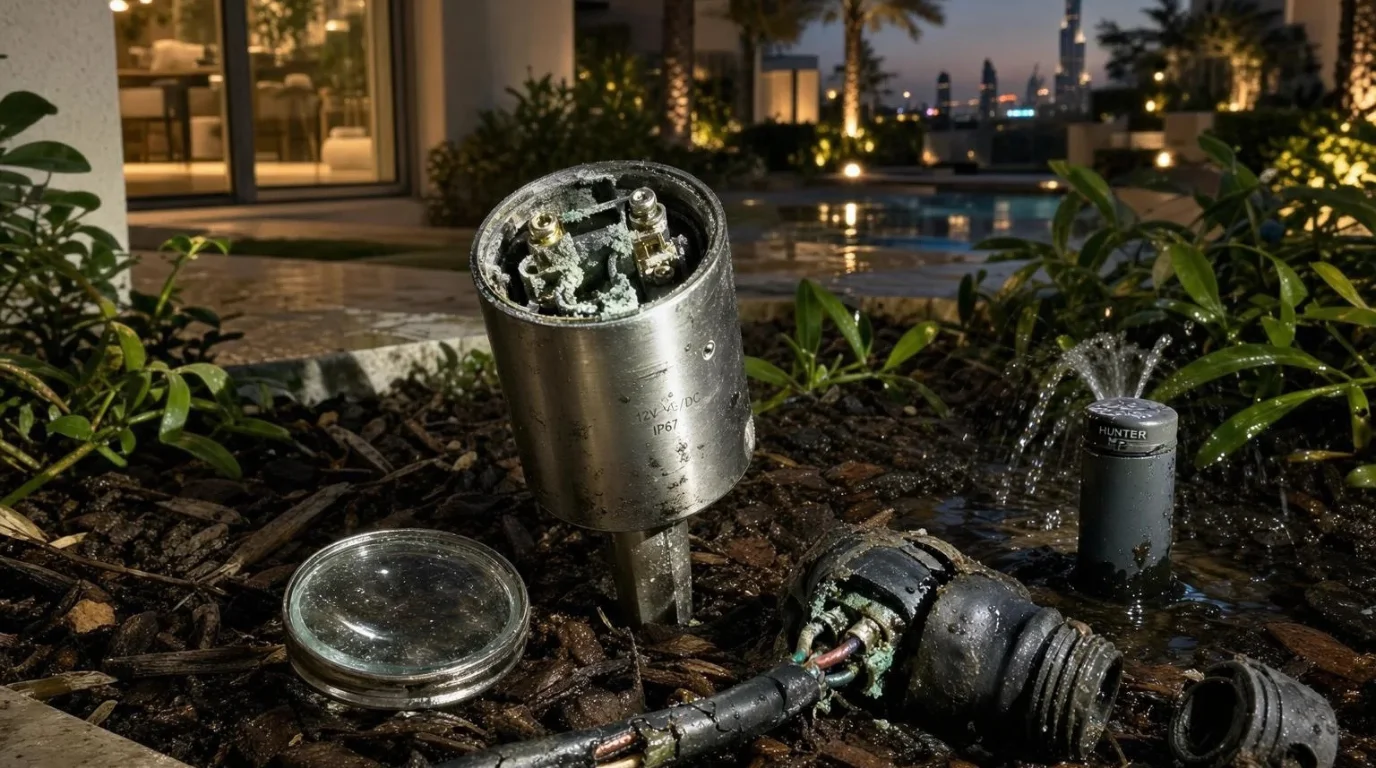
1. The splice in the mulch. Low-voltage landscape lighting has a transformer and a run of cable with branch connections at each light. Those joints are usually a wire nut and a burial, and over years the copper corrodes green, the connector swells, and water sits in it. The lights still work in dry weather, because the corrosion is not quite bridging anything. Then it rains, and the circuit trips. If your lights cut out in one zone after rain, this is usually where to look first, and it is not a lamp problem.
2. UV-brittle cable and sheathing. Ordinary flexible cable and cheap landscape wire do not survive Dubai sun. The outer sheath turns chalky, cracks when it is bent, and lets water track along the conductor. The specific failure mode to know: water travels along the inside of a cable jacket by capillary action and appears at the dry end, in a terminal or a transformer, hundreds of millimetres from where it entered. This is why “the light is fine but the junction box is wet” happens.
3. Irrigation and landscaping damage. A spade through a buried cable at a planting bed, a sprinkler head that has been wound up against a cable, or a cable left at 100 mm cover instead of deep enough, all show up weeks later as a trip. Buried supply cable is generally specified at around 500 mm cover, deeper under a drive, in armoured or protected form. Cable that a landscaper has “just put in a trench” will be found again by the next gardener. Backwash water from a pool filter run onto the same planted bed keeps the soil permanently damp around buried cable, and the reason so many Dubai pools backwash far more than they need to is in the one number in your plant room.
4. Salt and sand at the terminals. Between Jumeirah, the Marina, JBR and any coastal plot, the corrosion clock runs much faster. Steel fixings rust, aluminium heat-sinks pit, terminal screws seize, and sand packs into a photocell or PIR lens until the sensor either never switches or switches constantly. Coastal installations also need corrosion-resistant fixings and hardware, not just the correct IP rating.
The pattern of the trip is the diagnosis
Put the tools down for a day and watch it instead. Note these patterns before you change anything.
| What happens | What it usually means |
|---|---|
| Trips only while the sprinklers are running, resets afterwards | Water reaching a fitting, splice or cable damage in the irrigated zone |
| Trips during rain, works for weeks afterwards | Moisture ingress somewhere that dries out and then re-wets |
| Trips instantly and will not reset at all | A dead short or a genuinely failed component. Stop resetting it |
| One light is out and the rest are fine | Single fitting, its lamp or its local connection |
| Everything on the timer dies at dusk, works at noon | Photocell, contactor or timer failure, not a cable fault |
| Lights flicker or glow dimly at the far end of the run | Undersized cable, corroded joint or a transformer tapped wrong |
| The transformer is hot, buzzing or its output reads low | Transformer failing. On a low-voltage system, this is common after years of overload |
| A floodlight trips the whole board only when its PIR is triggered | Moisture in the sensor housing and a compromised element |
The row that matters most for your safety: a device that trips in wet weather, dries out, and then works again is not repaired. The path is still there and it will conduct again under the next storm, when the fault current may find something other than the RCD.
What you can check yourself, and where to stop
Safe to do with the circuit switched off at the board:
- Remove one fitting’s lens or cover and look inside for water, green corrosion, sand or a failed gasket. Dry it, inspect the seal, refit it, and note whether it returns.
- Pull the transformer out of its hiding place and check for corrosion on its terminals and a cracked or swollen casing. Many are mounted too low, behind a plant pot, where irrigation waters them nightly.
- Check that every outdoor socket’s cover is actually closed and its gasket intact, and that nothing plugged in has a swollen or discoloured plug.
- Look along the visible cable runs for scars, a fresh cut, a cable that has been nailed through a fixing, or a run sitting on the soil with no cover.
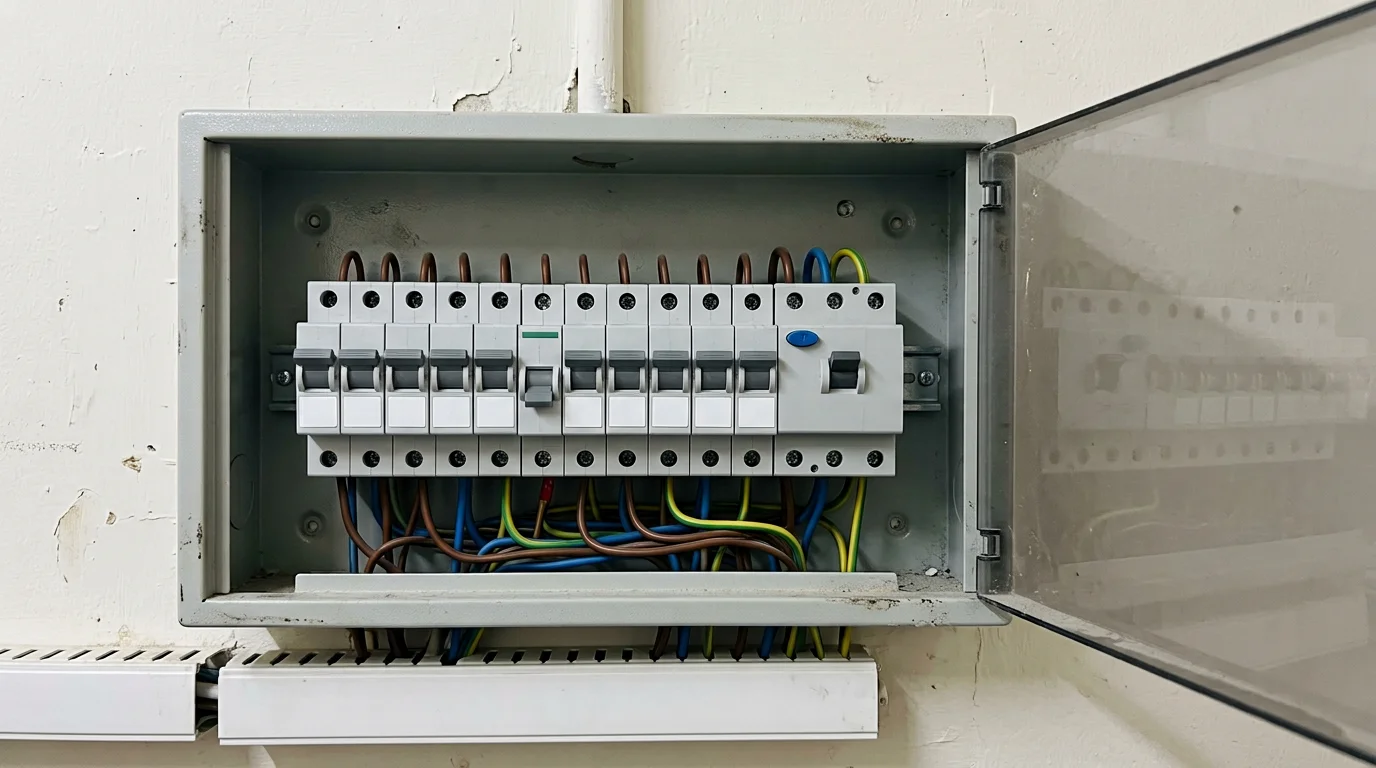
- Confirm what protecting the circuit. If the outdoor lighting is on a plain breaker with no residual current protection, that is a genuine upgrade item, not an optional one.
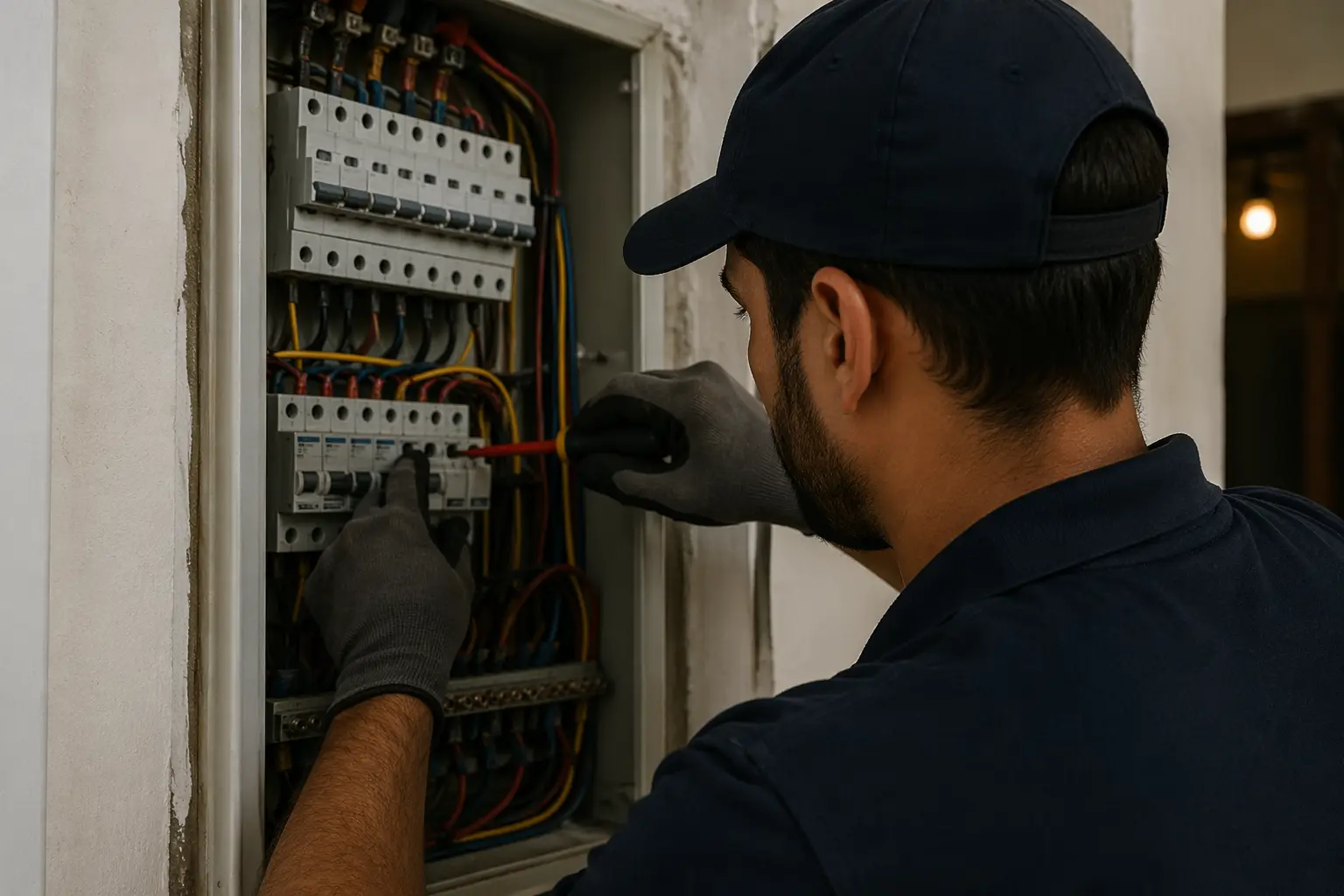
Where to stop: any excavation, any buried joint, anything inside the distribution board, any work on a pool or water feature circuit, and any fitting you cannot prove is dead. Outdoor fault finding beyond the visual stage needs an insulation resistance meter and, if the fault is underground, cable location and possibly a dig. In a commercial building this is also a line item on the office maintenance checklist, where exterior lighting and socket circuits get tested on the same quarterly cycle as the indoor boards. We covered the general “which device is tripping” logic in something is tripping your breaker, find out which one, and the warning signs that mean stop immediately are in electrical warning signs every Dubai homeowner should never ignore.
How a durable outdoor install is actually built
If you are having garden lighting redone, or a fault is being repaired permanently, this is the specification worth insisting on:
- Fittings rated IP65 for exposed locations, IP67 anywhere a hose or flood is plausible, with a sealed cable entry that faces downward.
- A drip loop before every fitting and every wall entry, so water runs off the cable rather than into it.
- Connectors that are rated for burial and wet locations: resin or gel-filled, not a wire nut wrapped in tape. Best of all, no joints underground at all, with a home run to each fitting where the layout allows it.
- A transformer mounted above ground level, ventilated, and not sitting where the irrigation wets it. Sized with headroom for the lamp load plus cable loss.
- Cable correctly sized for the run to avoid dim lamps, and buried to the specified depth in armoured or otherwise protected form, with warning tape above it so the next gardener finds it before the spade does.
- A dedicated circuit on its own 30 mA residual current device, so one wet lantern cannot take the pool lighting or the gate with it.
- Corrosion-resistant fixings on the coast, and stainless or hot-dip galvanised brackets everywhere else.
- Drainage holes kept clear in every fitting that has them, checked once a year.
A twenty-minute seasonal routine that prevents most of this
- Test every outdoor circuit’s residual current device with its test button, once a quarter. Same habit as indoors.
- After the first strong rains and after each storm season, open the nearest fitting and look for water.
- Rinse salt off coastal fittings with fresh water a few times a year, and check the steel fixings for rust staining.
- Keep mulch, soil and climbing plants off transformers, junction boxes and the bases of spike lights.
- Ask the irrigation contractor to mark the cable route before anyone digs, and photograph the run before it is covered.
- Trim plants back so lawn equipment cannot cut cables and so PIR sensors are not triggering on leaves.
- Photograph any exterior fitting that has tripped before you reset it. If you are handing a villa back, garden and exterior lighting faults are exactly what an agent records, and they are listed in the move-out walkthrough.
- Log any trip with a date and the weather. Three entries and a pattern is a diagnosis before a technician arrives.
If the outdoor circuit is only touched when it fails, this is precisely the sort of item that earns its place in an annual maintenance contract, where the quarterly test and the pre-season inspection cost a fraction of a garden rewiring.
What to book
We do the fault finding and the permanent repair: testing outdoor circuits, replacing fittings and transformers with the correct rating, re-terminating in the proper way, adding residual current protection where it is missing, and running new outdoor circuits with a licensed electrician, with whatever approvals your community or building requires. Electrical services covers it, and where the fault crosses into the poolside or a landscape lighting run, we work alongside the pool and tile teams rather than leaving you to coordinate. Request a call-back with the pattern from the table above, or read what villa owners say about how we handle fault finding.
Frequently asked questions
Why do my outdoor lights only trip when it rains?
Water is reaching a live part through a fitting seal, a connector, a damaged cable or a transformer that sits where it gets wet. It dries out, the insulation recovers enough to hold, and the circuit works until the next wet event. That cycle is a fault, not a fault that fixed itself.
Can an IP-rated outdoor light still fail?
Yes. The rating describes the enclosure as made and correctly installed. A cable entry facing upward, a missing gland, an unsealed knockout, a perished gasket, a blocked drain hole or a fitting that has spent four summers in UV all defeat the rating.
Should outdoor lighting be on an RCD?
It should be protected by a 30 mA residual current device, and the wiring standards most contractors here work to require that for outdoor circuits. If a light is on a circuit without one, adding protection is one of the cheapest meaningful safety improvements you can make to a villa.
Do I have to dig up the garden to find the fault?
Not usually. Visual inspection of fittings, transformers and terminators, plus testing each section of the run, identifies the fault in most cases. Cable location and a targeted excavation is the last step, when a buried joint or a damaged section is confirmed by test.
Will a low-voltage system stop tripping?
It can help, because a properly installed 12 or 24 volt system with a healthy transformer reduces shock risk. It does not stop the nuisance trip, since the leakage path is still there and the transformer or its primary side will usually still cause protection to operate. Fix the joint, do not change the voltage.
My pool light trips the board. Same problem?
Related but more urgent. Anything in or within splash zones of a pool has stricter requirements, and a swimming pool circuit that trips should be isolated and inspected before anyone swims. Do not reset a pool lighting circuit repeatedly to see if it holds.