Staircases are the least forgiving piece of stone in a house. A floor is flat, walked on in socks, and supported along its whole underside. A stair is a set of horizontal and vertical surfaces hanging off the edge of a structure, loaded on the weakest part, the front 100 to 150 mm, by a running child, a suitcase corner and someone carrying laundry.
Then someone lays marble on it in a villa that moves a little every summer.
We repair stone stairs in Dubai villas and townhouses constantly, and the calls group neatly into four faults. Knowing which one you have matters, because three of them are cheap early and expensive late, and the fourth is a repair most people were told to ignore.
1. The hollow sound: slabs that have debonded
Take a coin or your knuckle and tap every tread, from the nosing to the back edge, and every riser. Solid stone gives a short, hard, high note. A slab that has lost its bond gives a low drum, and you can usually hear the exact boundary where the sound changes.
On a stair, debonding is caused by a specific cluster of things. Full-contact bedding is harder on a vertical riser than on a floor. Nosing edges get impact loads repeatedly. Movement at the junction with a landing has nowhere to go without a joint. And large stone slabs need adhesive on the back as well as on the substrate, the back-buttering that gets skipped when a job is being finished quickly.
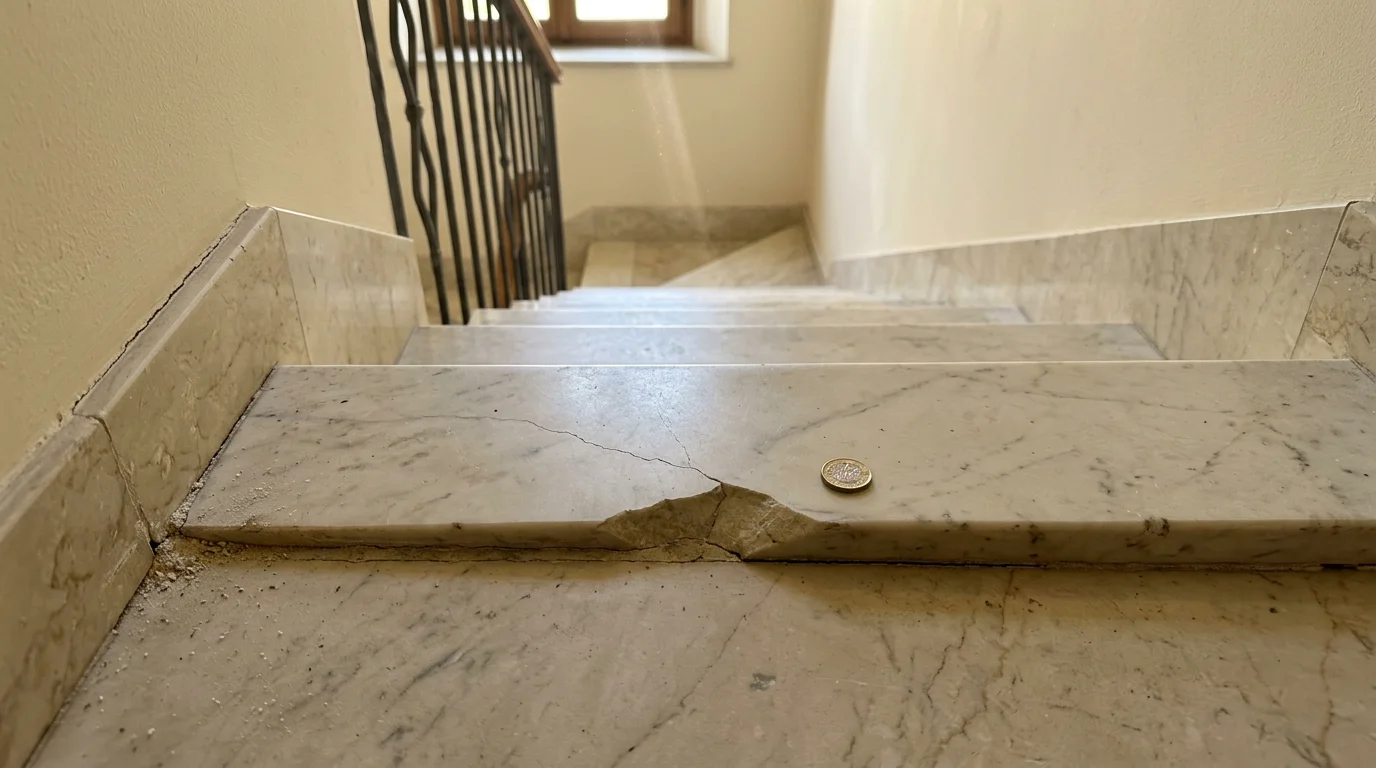
Why it matters before it looks like anything: an unsupported slab flexes a fraction of a millimetre every time someone steps near its edge. Stone does not survive that flexing for long. It cracks, usually in a straight line from the nosing back, and once it has cracked, the repair has changed from re-bonding a slab to replacing one and matching a finished surface that has aged for a decade.
The repair while it is still only a sound: lift the affected slabs, clean the substrate and the back of the stone, apply a suitable adhesive with full coverage and re-set, then renew the joints. A skilled team can do a flight of the worst steps in a day, with the stairs out of use for the cure period.
2. The creak: it is not the stone
People describe a creaking marble staircase as if marble were the thing making the noise. It is not. Stone does not creak. Something under it is moving: the concrete flight has a hairline movement joint opening under load, a timber stringer or landing is flexing, an old wooden sub-base has shrunk, or a steel stair has a loose bracket. The stone transmits it.
That is why the noise is useful and why it should not be tolerated. A creak is a movement report. Where it is accompanied by a crack in the grout joint at the wall, a hairline crack in a riser, or a step that feels springy under your heel, the movement is already working on the finish.
What actually helps: find and fix the movement, not silence it. Packing and adhesive injected beneath a loose slab can quiet a step for a while, which is exactly what makes it a bad idea as a “solution” if the substrate is still moving. On a genuine structural or framing issue, the joinery or structural repair comes first and the stone follows.
Sprinkling powder into a joint is advice written for timber stairs. Do not put it near stone joints in a home with kids; it does nothing for a bonded slab and it looks like a pest treatment.
3. Chipped and worn nosings
The front edge of every tread is the most damaged piece of stone in most villas. Two things do it: impact, from furniture, toys, and the toe of a shoe on the descent. And grit. Sand carried in from a pool deck or a garden entry is ground into the joint and the edge with every step, and that is why the bottom five treads of a flight are visibly worse than the top five in a Dubai house.
Chips get “fixed” badly more often than anything else in a home, because the standard trick, superglue or a white cement filler from the hardware store, leaves a patch that is the wrong colour, the wrong level and impossible to redo properly later without grinding more away.
A proper nosing repair rebuilds the edge with a tinted epoxy or polyester resin thickened with matching stone dust, built slightly proud of the surface, then ground and polished back flush once it has cured. Because the repair is shaped rather than smeared, it disappears at walking distance instead of at arm’s length.
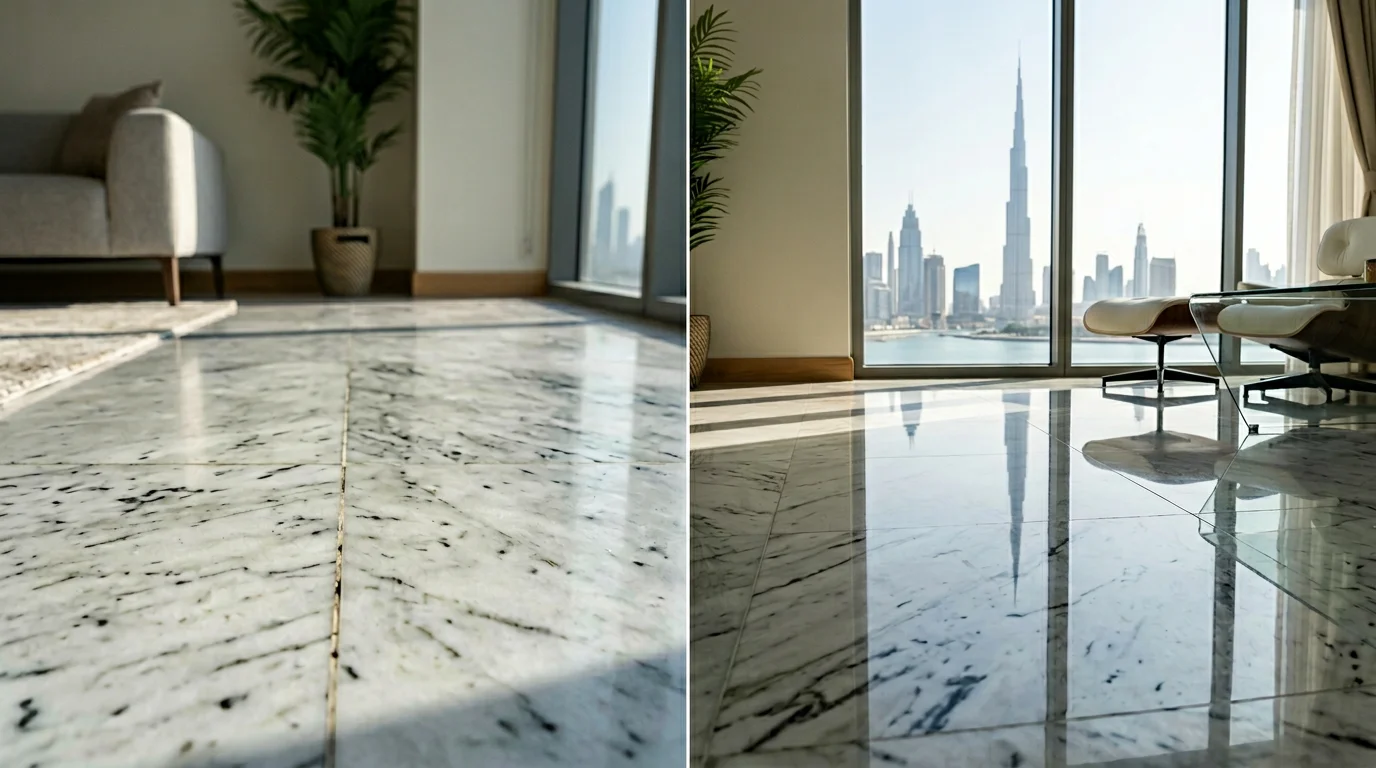
Now the part nobody warns you about. On a polished flight, polishing one tread creates a visible difference between that tread and its neighbours, because sheen is relative and light hits stairs from an angle. Localised repairs are for matt and honed surfaces. On a polished floor, the honest option is to grind and re-polish contiguous runs, or the whole flight, which is why stair work takes days rather than hours and why doing it at the same time as any floor polishing in the same house is cheaper.
4. Slip: the finish decision
Polished marble on a stair is genuinely slippery, particularly with a film of water from a pool deck or a bathroom. There are four real options, and each has a trade-off:
- Hone the treads. A satin finish grips better than a polish, hides etch marks and footprints, and takes the risk out of a bare wet foot. Trade-off: your staircase stops being a mirror. Many villa owners who switch say it was the best decision they made, and a few switch back.
- Mechanical anti-slip treatment. A professional etching treatment micro-textures the surface while keeping most of the look. Trade-off: it is a chemical process on natural stone, so it needs testing on a hidden step and the result is a slight sheen loss. We warn about the same class of acid damage on marble in how to remove hard water stains in Dubai, and the principle is identical.
- Sawn grooves or a flamed strip near the nosing. Reliable grip, invisible from two metres, and works on the highest-risk 50 mm. Trade-off: grooves collect grit and need vacuuming, and any textured band must be flush, since a proud strip becomes a trip for a toe catching on the way down.
- A runner or mat. Fine on a straight flight with a proper anti-slip underlay and fixed edges. On stairs, a loose rug is a worse accident waiting to happen than slippery stone.
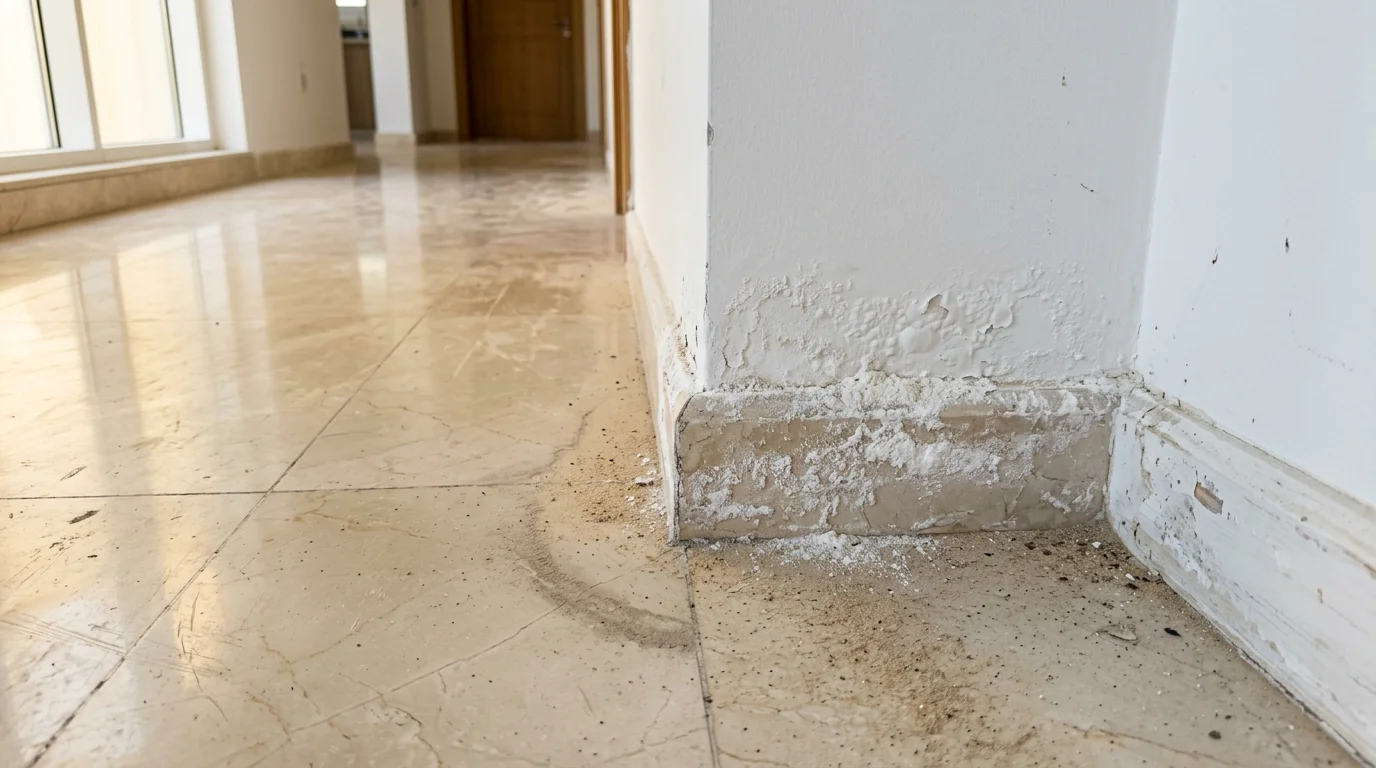
One more thing worth checking while you are on the stairs with a torch: hold the handrail and pull. Any movement at the fixing is a safety defect, not a repair list item, especially where baluster shoes are set into stone. Moisture in a stairwell joint corrodes anchors quietly, which is the same mechanism behind the white powder on a marble floor.
The defect that has nothing to do with the stone
Here is one that comes almost entirely from renovation work, and it is worth checking on your stairs tonight.
Stand at the bottom and step up. Then walk down and step onto the last tread onto the new floor. Does the height feel different from the middle of the flight? If someone laid marble, porcelain or a raised floor in the hallway or on a landing, the bottom riser has quietly grown, or the top one has shrunk, by 10 to 25 mm.
Risers within a flight need to be consistent, because you do not look at the stairs when you carry something. An inconsistency at the first or last step is the classic place people trip in the dark, and it is also one of the few faults that cannot be polished or bonded away. It usually needs the nosing of the step rebuilt, the landing lowered, or a compensating step introduced.
If you are about to re-tile the ground floor of a villa, tell whoever is doing the work to account for the stair landings before they start, not after. It costs nothing in the plan and a great deal in rework afterwards, which we cover on the material side in porcelain vs marble flooring in Dubai.
What a proper stair restoration looks like
- Tap-test the whole flight and mark every hollow slab, every cracked slab and every loose riser.
- Check the nosing profile, the joint at each landing, and the fixings at the balustrade.
- Lift what is debonded, clean, re-bond with full adhesive coverage, and let the flight carry no weight during cure.
- Rebuild chipped edges and corners with tinted resin, shaped to the original profile.
- Grind the flight to remove trip points, lippage and old repair patches, then re-polish or hone contiguous runs so the finish is uniform.
- Refinish or renew the joints with a flexible movement joint at the landings and at wall junctions rather than rigid grout everywhere.
- Seal after the assembly has dried, and treat the nosing zones first.
A single-flight job of that shape usually runs two to four working days once access and drying are planned, with the flight off-limits while adhesives and polish cure. Anyone quoting an afternoon for a full grind and polish on a curved flight is describing a buff, not a restoration. If your stairs are part of a wider refresh, the finish sequence matters, and the marble polishing cost guide explains why area pricing is quoted per run rather than per patch.
Call someone this week if
- A slab moves, dips or sounds like a drum and there is a crack running from the nosing.
- A tread has lost a chunk big enough to catch a shoe or a child’s toe.
- The handrail or a baluster moves when you pull it.
- You can feel a height change at the top or bottom step.
- Someone has fallen on the stairs, even without injury. That is the point at which the slip question stops being cosmetic.
We work on stone stairs end to end, from re-bonding to grinding, polishing and sealing: stone and marble restoration and, where the movement is in the joinery, carpentry. Send us a photo of the step, a short video of you tapping it, and a shot of the nosing edge, and we will tell you whether this is a patch, a re-bond, or a flight restoration. Start here, or read what villa clients say about how we run stair jobs.
Frequently asked questions
Why does my marble staircase creak if marble cannot creak?
Because the noise is movement in the structure underneath: a flexing landing, a loose substrate, an opening movement joint. Stone transmits it. Treat the creak as an early warning, because the same movement eventually cracks the slab rather than just annoying you.
Can a loose stone tread be re-fixed without replacing it?
Often yes, if the slab is sound. The tread is lifted, the old adhesive is removed from both faces, and the slab is re-bedded with full coverage and left unloaded while it cures. Cracked slabs, or slabs with chipped edges that no longer have matching replacements, need to be made good or replaced.
Why not just polish the one bad step?
Because sheen is judged against its neighbours and light rakes across a stair at an angle. A single polished tread on an otherwise aged flight shows as a bright patch. On honed or matt stone this is much less visible; on a polished flight the correct scope is contiguous runs or the whole flight.
How do I make marble stairs less slippery without ruining them?
Safest options in order of practicality: keep grit out with mats at both ends, hone the treads, add sawn grooves or a flush flamed strip at the nosing, then consider a professional anti-slip treatment. Avoid loose rugs, and never add a proud nosing strip a toe can catch on.
Is a small chip in a stair nosing worth repairing?
Yes, immediately and properly. The nosing carries the load and takes the impact, so an open chip lets water in and lets the edge break further. A tinted resin rebuild done early is invisible at walking distance. A DIY filler patch done late means grinding more stone away later.
Do stairs in a new villa move enough to crack stone?
All buildings move, and new villas settle and respond to temperature swings most in their first years. That is exactly why movement joints at landings and full-contact bedding matter. Where cracks appear in a straight line across several treads, have it looked at while it is still a snagging conversation.