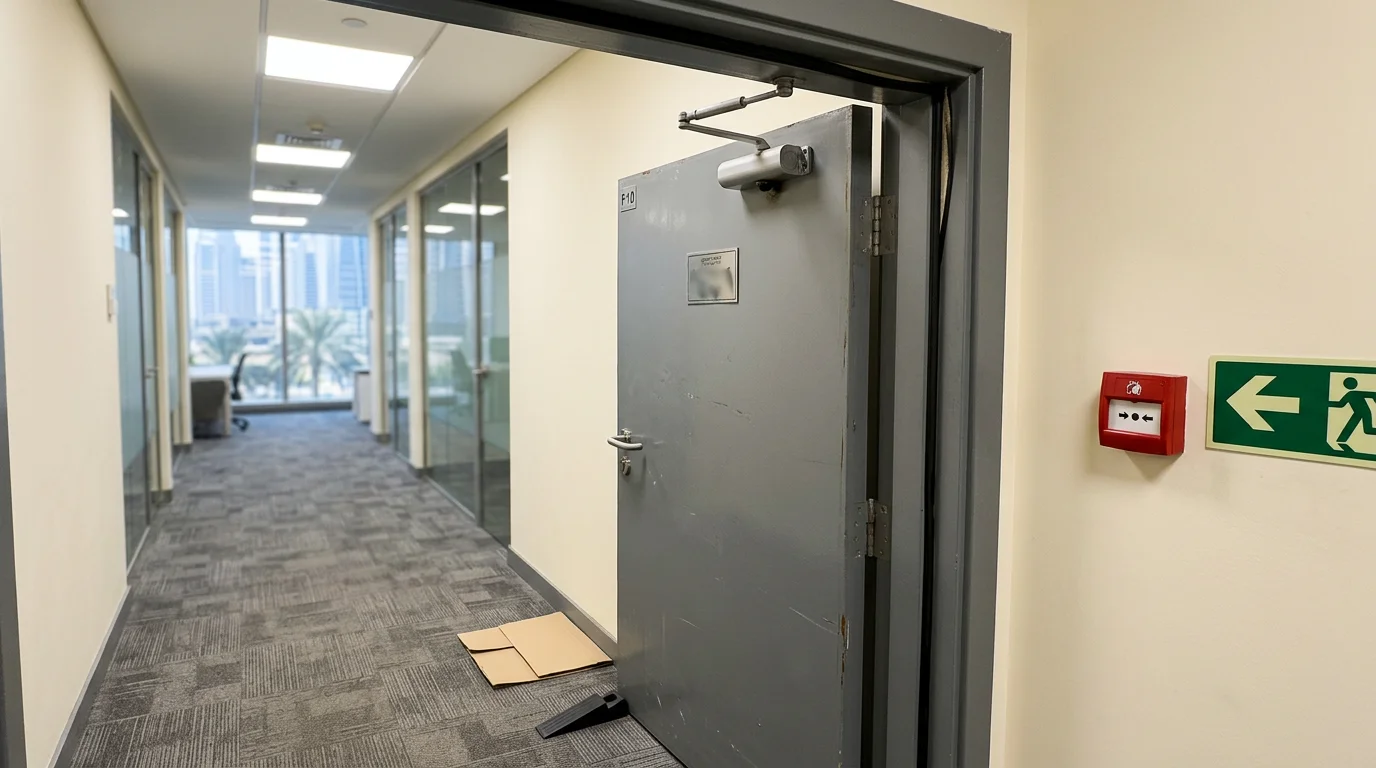
In most Dubai offices the door that fails a fire inspection is not damaged, missing, or obviously broken. It is the stairwell door someone wedges open with a fire extinguisher because it is heavy and the team carries coffee through it forty times a day. It is the corridor door that swings shut but never clicks. It is the closer that a facilities person adjusted to be gentler two years ago and nobody adjusted back.
Those three are all failures, and they are the common ones. We do the joinery side of this work in office buildings, so here is how to check every door in your premises in about three minutes each, what the standard actually expects, and which fixes are yours versus which one needs a fire contractor.
What the door has to do
A rated door is an assembly: leaf, frame, hinges, closer, latching hardware, seals and glazing, tested together as a set and certified as a set. That is why the small modifications that seem harmless are the ones that void it. Two functional requirements drive everything else:
- Self-closing. Released from any open position, the door returns to fully closed on its own, against the latch and against the air pressure in the building.
- Self-latching. The latch bolt engages the strike plate every time. A door that closes but stops a few millimetres short of latched is not compliant. This is the single most common thing people get wrong, because a door that shuts looks fine.
The inspection standard most fire contractors here work to, NFPA 80, also requires fire door assemblies to be inspected and tested annually, with the record kept. Under UAE law, Civil Defence enforces fire and life safety requirements and commercial premises must hold a valid fire safety certificate, so door condition is not an abstract point. Your building’s approved drawings and your fire maintenance contractor define what applies to your specific doors, so treat the checklist below as the walk, not as a legal certificate.
The three-minute door test
Do this on every rated door: stairwell, riser rooms, plant room, corridor doors, kitchen and back-of-house doors, and the doors between your suite and the common parts.
- Remove whatever is holding it open. Wedge, mat, hook, extinguisher, bin. If the door has a magnetic hold-open device, test that it releases when the alarm is tested, not that it falls over when you pull the closer arm.
- Open it fully and let go. It must close and latch without any help. Do it three times. A door that latches twice out of three is a door that will not latch when someone is in a hurry.
- Open it to about half and let go. Same requirement.
- Listen for the click at the end. If you hear the door hit the frame but not the latch throw, watch the bolt. It should be greased-free but moving, and it should meet the strike, not ride above or below it.
- Look at the closer. Check for an oily film or a drip at the two ends of the body. A weeping closer has lost its damping and is a replacement item, not an adjustment item.
- Check the seals. Intumescent strips should be continuous and firmly seated in their groove, with no gaps at the top corner. Any paint built up thick on them matters.
- Check the gaps with a coin. Commonly used tolerances are tight at the top and sides, roughly 3 mm for steel and up to 5 mm for timber assemblies, with the underside usually kept at or below about 19 mm unless there is a threshold. The frame is not allowed to be bowed away from the wall.
- Find the label. It sits on the top edge or the hinge edge of the leaf, or inside the frame. If it has been painted over or is missing, you have a certification problem rather than a repair problem, and that is a fire contractor conversation.
What each symptom means
| What you see | Most likely cause | Who fixes it | How urgent |
|---|---|---|---|
| Door closes but does not click | Latch speed set too low, strike misalignment, or sagging top hinge | Maintenance contractor or carpenter | Fix this week |
| Door slams, then bounces back unlatched | Latching action too fast, no sweep control, or rebound from a stop | Adjust or replace closer | Fix this week |
| Door drifts shut slowly and stops short | Weak or leaking closer, over-adjusted valves, or floor friction from a mat or a rug | Replace closer, remove obstruction | Fix this week |
| One leaf of a pair closes before the other | Dead coordinator, or the coordinator arm bent | Re-adjust or replace coordinator | Fix this week |
| Smoke or light visible past the door edge | Frame racking, gaps out of tolerance, seal missing | Joinery plus fire contractor | Do not defer |
| Bare metal showing at the top corner | Hinge wear or screws pulling out of a timber frame | Carpenter, and re-anchor the frame | Do not defer |
| Wedge taped to the door by the staff | Your policy, not a hardware fault | Building management conversation | Today |
Closer adjustment, the two screws that matter
Most surface closers have two speed valves: one controlling the main sweep from full open to just before the latch, one controlling the final latching action. The classic office mistake is that someone finds the door heavy, tightens the wrong screw to stop it slamming, and quietly removes the energy from the last 15 degrees of travel. The door then looks fine and never latches.
What is reasonable to know before you touch anything:
- A closer has a power size matched to the door’s width and mass. If a door genuinely needs too much force to open, the answer is a correctly sized closer, a low-energy power operator, or in some cases a heavier-assist unit. It is not to weaken the closer that is there.
- If the valves are already near their limit and the door still does not latch, the closer is finished. Adjusting a tired unit further only hides it for a few months.
- Turn a valve a quarter of a turn at a time, and test from full open each time. Quarter turns are how you find the setting. Half turns are how you flood the valve.
- Never back a valve all the way out. On many units that releases fluid and ends the closer’s life.
- A leaking body is replaced, always. No adjustment brings damping back.
- Replacement hardware has to be compatible with the certified assembly. Putting any cheap closer on a rated door is the fastest way to make a compliant door uncertified.
Five things tenants do that void a rated door
- Wedging or propping, including the hook-on-the-wall that “only” holds it open at 30 degrees.
- Painting the leaf, the frame and the seals, especially the label. Thick paint on an intumescent strip slows it, and paint over a label makes the door unverifiable.
- Drilling for a sign, a push plate, a coat hook or a cable. Any hole through a rated leaf needs to be dealt with by the party that can certify the repair.
- Adding a bottom brush, a draft excluder or a threshold without checking the clearance, since the underside gap is a controlled dimension.
- Swapping a hinge or a latch with a non-equivalent part because it “fits”. It may fit. It may also be the reason the assembly no longer performs.
Why the fit-out contractor is usually the right call
There is a split in how offices maintain doors, and it is worth getting right. The life-safety contractor certifies the assembly: rating, seals, labels, hold-open integration and the record that goes with your fire certificate. The joinery and maintenance side is what makes the door actually behave: hinge anchorage, frame alignment, latch strike filing, closer supply and setting, floor clearance, and reinstating doors after an office change.
A lot of the defects on the walk above are joinery defects. Door sagging because the top hinge screws have lost grip in a timber frame is not fixed by a new closer. A strike plate that has been moved twice by three different contractors will never latch well until someone resets it in a fresh position with a reinforced plate. Those are days of cheap work that make an inspection pass.
If your office is in a tower with pressurised stairwells, a stair door that will not close and latch shows up during the annual pressurisation test as a failure of the stairwell to hold its pressure. That is the scenario where a small latching problem becomes a building-wide one, because the whole test has to be redone.
The asset list that makes inspections cheap
Buildings that pass fire door inspections with least drama are the ones with a schedule. It takes an afternoon and it turns a random argument into a list of numbered defects with photos and dates.
| Column | Example |
|---|---|
| Door ID | FD-04, stair core, level 11 east |
| Rating and label status | FD60, label present, legible |
| Closer make and setting | Surface closer, both valves mid-range |
| Last tested | 2026-09-14, closes and latches from 90 and 30 degrees |
| Defects | Minor rub at latch edge, seal intact |
| Action and owner | File strike, ArabCare joinery, closed 2026-09-21 |
| Photo evidence | Before and after, dated |
Keep it in one sheet, share it with the fire contractor before they arrive, and you will spend your inspection on the doors that matter rather than arguing about the ones you have already fixed.
When we get called
Fire door work on an office floor is usually a combination of joinery, ironmongery and, where a hold-open device is involved, electrical. We do the joinery and maintenance side and coordinate the rest, which is exactly the shape of work that belongs in an annual maintenance contract rather than in a panic the week before the Civil Defence renewal. Start with our contact page, or read what facilities managers say about how we run jobs. For the wider routine, the office maintenance checklist covers what else gets forgotten between fit-out and handback.
Frequently asked questions
Is it illegal to wedge a fire door open in a Dubai office?
It is a defect and a common automatic failure at inspection. Under UAE law, Civil Defence enforces fire and life safety requirements for commercial premises, and doors held open by wedges or furniture defeat compartmentation. If a door needs to stay open for operational reasons, the answer is an alarm-linked hold-open device installed and tested as part of the system, not a wedge.
My fire door closes but doesn’t latch. Does that matter?
Yes. Self-latching is a separate requirement from self-closing, and a door that is not latched cannot hold smoke or pressure. It is also the failure an inspector tests for by letting the door go and walking away.
Why does my door slam, and is a slow door better?
Neither extreme is right. Slamming usually means the latching speed is too high or the closer is worn, and a door that slams damages the frame and the leaf. A door that closes too gently usually fails to latch. Correct behaviour is controlled through the swing and decisive in the last 15 degrees.
Can I adjust the closer myself?
Small speed adjustments are within most facilities teams’ capability, provided you understand which valve does what, you only turn a quarter at a time, and you test from full open after each turn. Replacing the unit or changing the power size is not a DIY item, because the hardware has to remain compatible with the certified assembly.
The door is heavy and staff complain. What is the right fix?
Correct closer sizing, hinge condition and, where accessibility is a real issue, a low-energy power operator. Reducing closer tension is the wrong answer, because the door then fails to latch under normal building air pressure.
How often should fire doors be inspected?
Annual inspection and testing of the assemblies is the norm under the standard most contractors here reference, and your building’s own regime may be stricter. Some items, like the wedged-open problem and the latch test, are worth checking monthly on a walk.