Here’s a decision most people don’t realise they’re about to make until a contractor asks them mid-conversation: “Gypsum or POP?”
Cue the polite nod that means “I have absolutely no idea what you just said.” Don’t worry, nearly everyone does it. These two words get thrown around like everyone was born knowing the difference, and yet they quietly decide how your ceiling looks, how long it lasts, and how much you’ll be muttering about cracks in three years’ time.
I fit both, all over Dubai, so I have no dog in this fight, I just want you to pick the right one for your room. Let me clear it up the way I would if you asked me on-site, coffee in hand, before the dust sheets go down.
First, what are we even comparing?
Both are “false ceilings”, a second ceiling built below your real one, used to hide wiring and ducting, house recessed lights, and create those lovely cove-lighting effects everyone wants. The difference is entirely in the material.
POP (Plaster of Paris) is the old-school method. A powder mixed with water into a paste, applied by hand, often over a chicken-wire mesh or onto board, and shaped in place. Think of it as sculpting your ceiling wet, on site.
Gypsum board is the modern method. Ready-made gypsum panels (you may know them as drywall or plasterboard) screwed onto a metal frame, with the joints filled and finished. Think of it as assembling your ceiling from factory-made pieces.
Same family of material, honestly, gypsum is literally what POP is made from. But how they’re used changes everything that matters to you.
The honest side-by-side
| POP (Plaster of Paris) | Gypsum Board | |
|---|---|---|
| How it’s made | Mixed and shaped by hand on site | Factory panels fixed to a metal frame |
| Finish | Seamless, great for curves & custom shapes | Clean, flat, sharp modern lines |
| Speed | Slower, it’s wet work that must dry | Faster, dry install, less mess |
| Mess on site | High, wet plaster, more wastage | Low, cleaner, drier process |
| Cracking over time | More prone to hairline cracks | More stable, resists cracking |
| Repairs | Can be patched and re-skimmed in place | Damaged panels swapped out |
| Custom curves & domes | Excellent, its big strength | Limited, better for flat/geometric |
| Cost | Often cheaper upfront (labour-dependent) | Slightly higher, but consistent |
| Best for | Ornate, curved, traditional designs | Modern, flat, fast, low-fuss projects |
Where each one genuinely wins
Tables are neat, but here’s the why behind them.
POP wins when you want shapes
If your dream ceiling has curves, domes, arches, or ornate detailing, POP is hard to beat. Because it’s shaped wet and by hand, a skilled plasterer can create seamless, flowing forms that panels simply can’t. There are no joints to hide, it’s one continuous surface. For a grand majlis, a traditional villa, or anything with sculpted character, POP earns its place.
Its other draw is cost: it’s often a bit cheaper upfront, especially where labour is competitively priced.
Gypsum wins when you want clean, fast, and stable
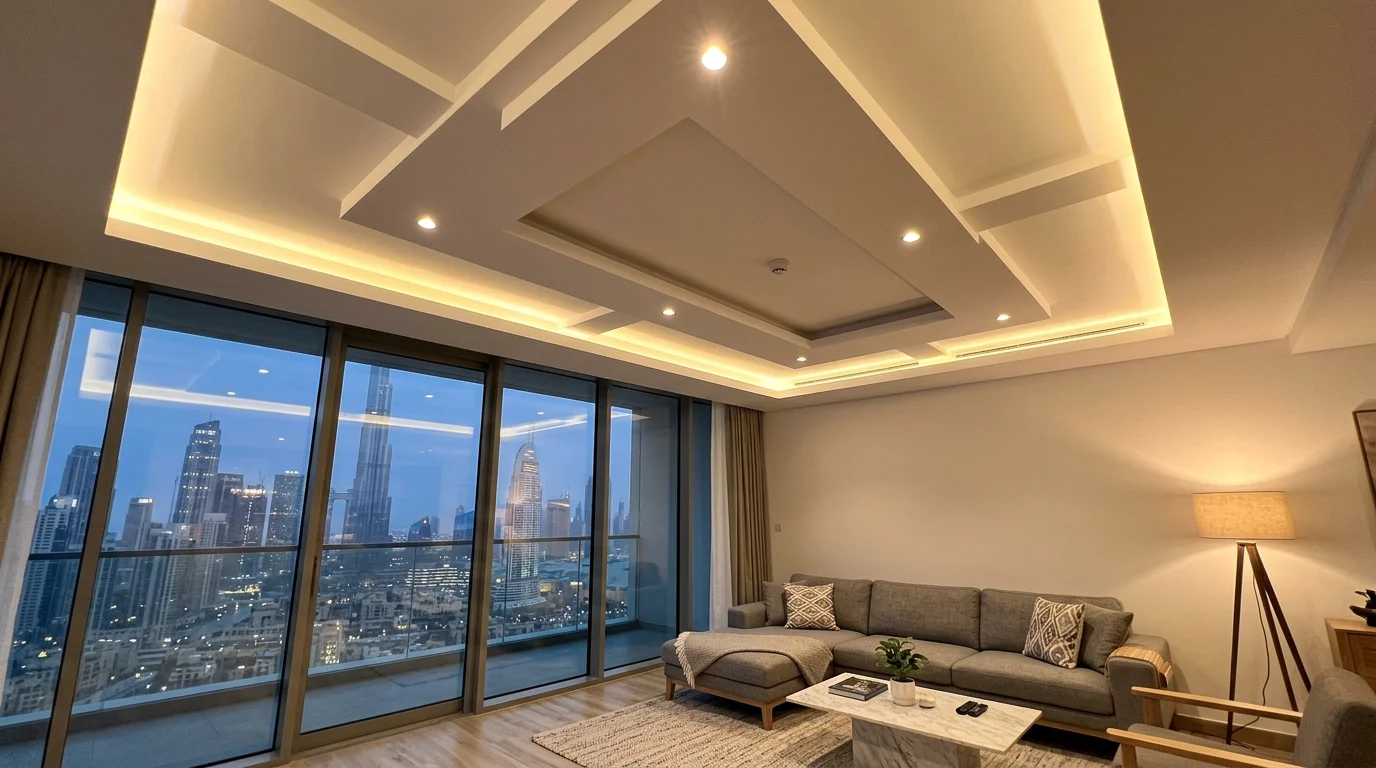
For the modern, flat, minimalist look most Dubai apartments and new villas are going for, crisp lines, recessed spotlights, a slim cove for LED strip lighting, gypsum board is usually the smarter pick.
Why I lean toward it for most modern homes:
- It’s faster and cleaner. Dry install, far less mess, quicker to live with. In an occupied apartment, that matters a lot.
- It cracks less. This is the big one (more below).
- Repairs are tidy. Damage a section? Swap that panel. No re-plastering a whole area.
- It’s predictable. Factory panels mean consistent thickness and finish.
This is why our gypsum & false-ceiling work leans heavily on board for modern interiors, it’s simply the lower-drama choice for most homes.
The Dubai factor nobody mentions: cracks and humidity
Here’s the part that actually decides it for a lot of people, and it’s specific to living here.
Dubai homes go through a relentless cycle: brutal heat outside, cold AC inside, high humidity for months. Ceilings expand and contract with that, over and over. And POP, being a rigid hand-applied plaster, is more prone to developing hairline cracks along that stress over time, especially if it wasn’t mixed or cured perfectly in the first place.
The number-one false-ceiling complaint I get called out for? Hairline cracks in POP ceilings a couple of years after installation. It’s rarely a disaster, it’s patchable, but it’s the kind of recurring annoyance that makes people wish they’d gone with board.
Gypsum board, sitting on a flexible metal frame with proper jointing, tends to ride that movement better and stay looking clean for longer. Neither is immune , quality of installation matters more than material, honestly, but if low-maintenance is your priority, board has the edge in Dubai’s climate.
One more thing both share: water is the real enemy. A leak from the AC or the floor above will stain and sag either material. If that’s a risk in your space, ask about moisture-resistant gypsum board , it’s made exactly for wet-prone areas. (And if you’ve already got a brown ceiling stain, that’s usually a leak talking, worth reading up on the warning signs before it spreads if there’s wiring nearby.)
Don’t forget what lives inside the ceiling
Whichever you choose, remember the false ceiling is also hiding your wiring and lighting , so it’s worth planning that properly at the same time. Recessed spotlights, LED cove strips, and any electrical points are far easier (and cheaper) to get right before the ceiling closes up than after.
The same goes for any custom carpentry or joinery that ties into the ceiling line, bulkheads over wardrobes, integrated shelving, and so on. Coordinate it all in one go and you avoid opening a finished ceiling back up later.
So… which should you pick?
Here’s my genuinely simple decision rule:
- Want curves, domes, ornate or traditional detailing, and a lower upfront cost? → POP.
- Want modern flat lines, fast clean installation, fewer cracks, and easy repairs? → Gypsum board.
- Not sure / it’s an occupied apartment / you hate mess and maintenance? → Gypsum board, nine times out of ten.
And the honest truth underneath all of it: the installer matters more than the material. A brilliantly fitted POP ceiling beats a badly fitted gypsum one every time, and vice versa. Whichever you choose, choose the team carefully.
Quick FAQ
Is gypsum better than POP for a false ceiling?
For most modern Dubai homes, yes, gypsum board installs faster, makes less mess, resists cracking better, and is easier to repair. POP still wins for curved, domed or ornate designs where its hand-shaped, seamless finish is hard to match.
Which is cheaper, POP or gypsum?
POP is often a little cheaper upfront, mostly on labour. Gypsum can cost slightly more but tends to be more predictable and lower-maintenance over time, which can make it cheaper in the long run.
Do POP ceilings crack more than gypsum in Dubai?
They can. The heat-to-AC cycle and humidity in Dubai stress rigid plaster, so POP is somewhat more prone to hairline cracks over the years. Gypsum board on a flexible metal frame usually handles that movement better. Good installation reduces cracking in both.
Can a false ceiling handle Dubai’s humidity and leaks?
Standard board and POP will both stain and sag if water reaches them. For wet-prone areas, moisture-resistant gypsum board is the better choice, and any leak should be fixed before it damages the ceiling.
Which false ceiling is best for LED cove and spotlights?
Both can house recessed spotlights and LED cove lighting. Gypsum board is especially popular for crisp modern coves and clean lines, while POP suits curved or decorative lighting features. Plan the wiring before the ceiling is closed.
The short version
POP and gypsum are close cousins that behave very differently once they’re on your ceiling. Choose POP for curves, character and a lower upfront price. Choose gypsum board for modern flat lines, a faster cleaner install, and fewer cracks down the road , which, in Dubai’s climate, is why it’s the default for most modern homes. Then spend your real energy on picking a team that installs it properly, because that’s what you’ll actually be looking at for the next decade.
Planning a new ceiling? ArabCare designs and installs both gypsum and POP false ceilings across Dubai, with cove lighting, partitions and clean, dust-managed installation. Book a free design visit, get in touch, or see what Dubai homeowners say.